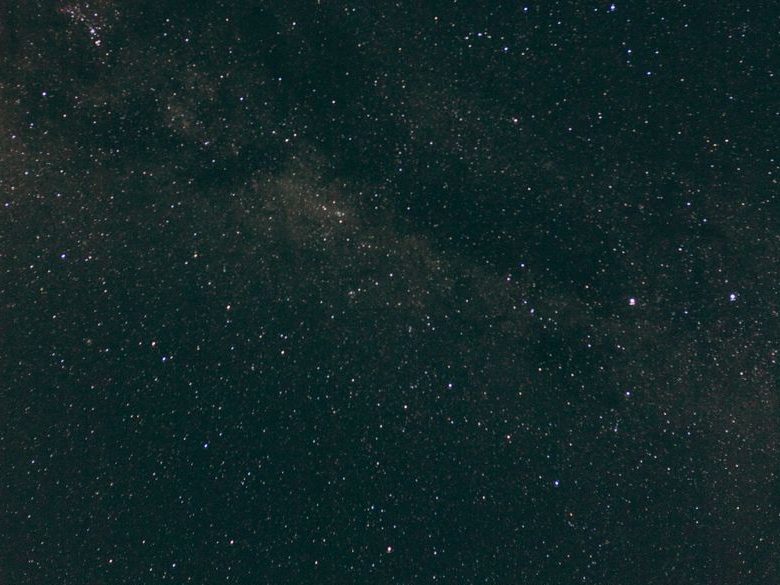
Night, or the fall of such as it were, has eternally been the centerpoint in time and space for complex mechanisms of organic and non-organic existence. That is indeed how one so plainly can define it. It is, scientifically speaking, when the Earth shifts from facing the Sun to its Moon as it rotates on its axis, 365 days a year, upon millions and millions of years. Truly making us, and whatever beliefs we relate to nightfall, seem kind of useless if by life’s very nature night is but the normalcy of our rather short existence. Yet, for once, think about what you feel when the sky starts to dull: painting purples, blues, greys, black, and all other colours which you could probably describe better than I.
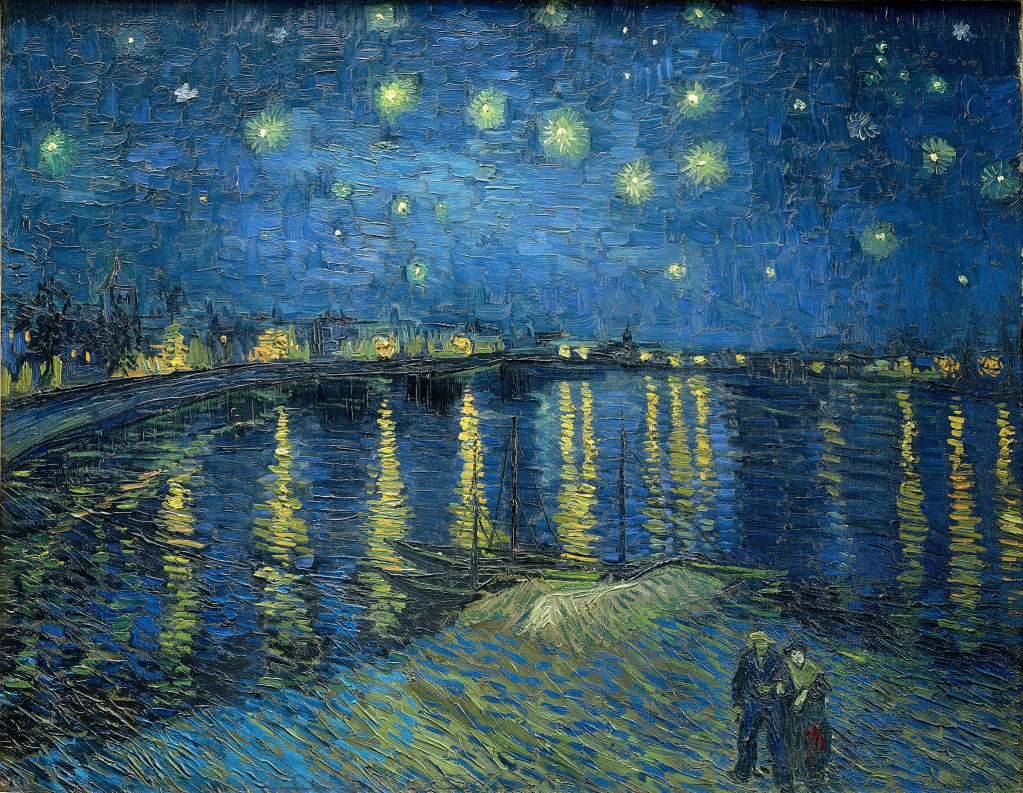
Vincent van Gogh – Starry Night Over the Rhône
Nowadays, most of us—like in many ways all animals do—usually think about nightfall rather subconsciously in routine-based matters. Whether it is the end of the work shift, or the beginning for others, the time to reminisce or study, or the perfect excuse to get absolutely drunk or partake in other debaucherous activities. This is just the cusp of what nightfall can represent: a familiarity we hold so dear that we should call nightfall a friend, a mortal enemy, a teacher, so immovable in its constancy as time itself, that we have no choice but to accept its presence. For most animals on Earth, the constancy is intertwined so well that life’s natural order follows these mechanisms (though to note that a ‘natural order’ does not necessarily follow strict patterns, free will sits above all else). Moreover, the natural world follows and depends on that such darkening of the sky and the appearance of our moon.
However, for humanity, nightfall is an emotional illusion, a trap even, because we have turned a scientific process into one of the soul, which no raw emotion, fulfilment or disdain can escape. This author argues that this is a necessary, and terribly unavoidable, predicament. Why? Because it is by all stretch a perfect recognition of our own mortality, and the human experience on Earth.
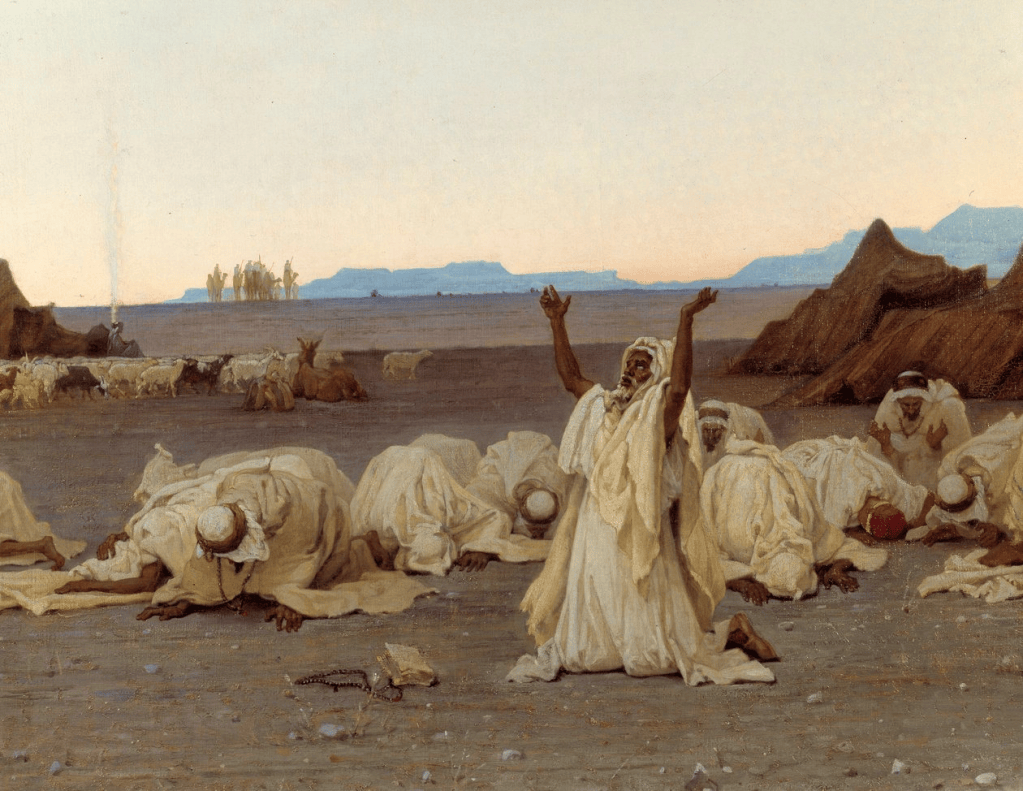
Gustave Achille Guillaumet – Evening prayer in the Sahara Desert.
In the literary world, there exists an endless vault of examples to draw from which explore the role of nightfall in any human feeling and desire. Sun Tzu, in The Art of War, describes the practical and metaphorical implications of nightfall in the manoeuvring of armies, while Monty Soutar in Kāwai: For Such a Time as This, describes the anxiety that nightfall could bring to a besieged army. While seemingly different, the practicality of which Sun Tzu describes is none other than a consequence of the emotions caused by nightfall, leading certainly to anxiety, among others. In the general understanding that nightfall represents that illusion of uncertainty, that a moving shadow in your war camp could be a callous enemy with a sword, suddenly nightfall no longer pertains to a scientific world.
For others, such as for Héctor Abad Faciolince or Alexander Pushkin, nightfall represents the intensification of our memories and thus our feelings; the perfect environment to cultivate melancholy and nostalgia. Be it the silence of the night which brings out a poet’s true romantic feelings, or the reminder of those so casually and unjustly killed, of which only insomniac nights remain, the emotional trap is complete. Furthermore, in many regards, nightfall can occasionally act as the immediate trigger for such strong feelings, as poet Sylvia Plath puts it: ‘…the bright, sunny world outside suddenly vanishes under a dark, suffocating glass bell jar, turning everything heavy, dark, and hopeless in an instant.’
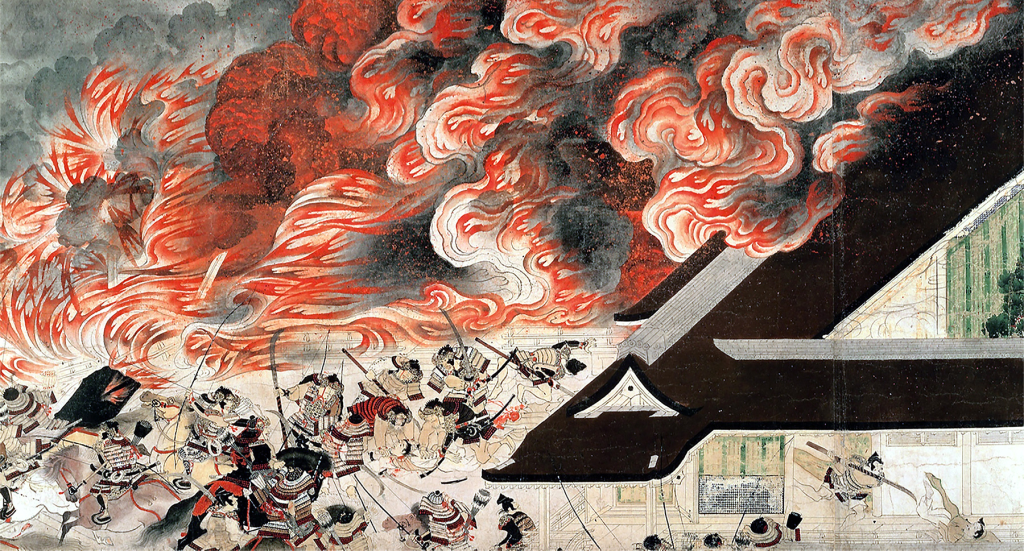
Night Attack on the Sanjô Palace, Illustrated Scrolls of the Events of the Heiji Era (Heiji monogatari emaki)
Naturally, the association of nightfall to human emotion also leads to the exalting of dusk and dawn. Why? Because night can easily be portrayed to be the constant: never-changing and flat. It can be a prolonged time for a good or an evil, while dawn and dusk can be portrayed as the change. For instance, for Oscar Wilde in The Picture of Dorian Gray, nightfall represents the comfort of illusions, desires and false hopes which dawn strips away, going back to ‘the real life that we had known.’ On the other hand, for Patrice Lumumba, nightfall is the darkness of oppression and tyranny, of which a hopeful dawn with a bright future will rise to end, expressed even in his last writing before he was tortured and killed. Ultimately, what is captured in the literary world is the desire to utilise, influence, fight against, or otherwise feel the emotions attributed to nightfall.
In a final stance (and keeping in the spirit of Halloween), not only is it felt in the realm of the natural and human, but indeed can be analysed within our so-called, ‘supernatural’ world. Even if the beings of myth, legend or indeed of fact do exist, they must, in their own ways, be limited to the conditions of nightfall. Whether they express and are influenced by nightfall as humans are, or simply pertain to a natural order as our very planet does, it cannot be stated. Nevertheless, nightfall, as are the debates about this supernatural world, is clear evidence that rational thought and the irrational often cannot exist without the other. At the end of the day, the fall of night can be argued simply as a scientific event in time, yet it is through our human nature and experiences that our souls are left bare in its passage.
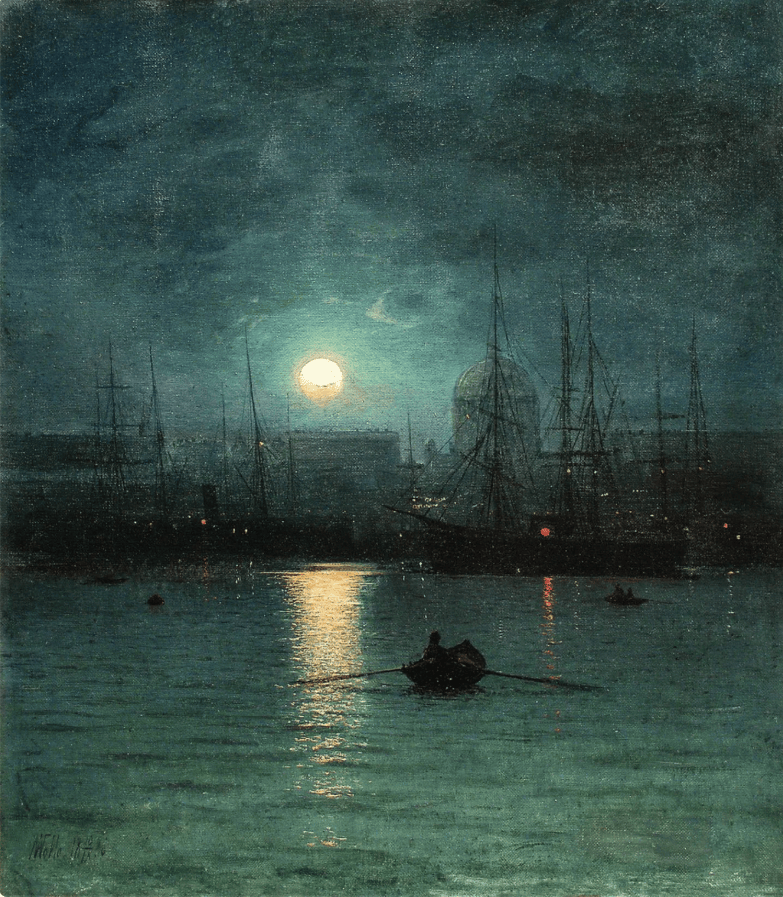
Lev Feliksovich Lagorio – Moonlit Night
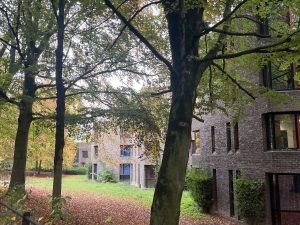
Image: Alexander Mass via Pexels
van Gogh, V. (1888). Starry Night Over the Rhône [Oil on canvas]. Musée d’Orsay, Paris.
Guillaumet, G. (1863). Evening Prayer in the Sahara [Oil on canvas]. Musée d’Orsay, Paris.
Night Attack on the Sanjô Palace (c. 13th Century AD). [Illustrated scrolls]. Museum of Fine Arts, Boston.
Feliksovich Lagorio, L. (1898). Moonlit Night. [Oil on canvas] Primorye State Picture Gallery, Vladivostok.


Leave a Reply