Content warning: this article refers to slavery and other instances of racial exploitation and violence.
In October 2025, Durham University, in conjunction with Durham Cathedral, launched a walking tour of Durham titled ‘Absence/Presence of Durham’s Black History.’ DU academics, including Professor Nayanika Mookherjee (Anthropology), Dr Liam Liburd (History), and Dr Sol Gamsu (Sociology), created online resources for a self-guided walking tour. The tour was designed to showcase ‘absent presences’, referring to the concealed histories of typically revered individuals and institutions, particularly those celebrated in Durham Cathedral and Durham City Centre. The curators emphasise that the purpose of the tour is to encourage ‘thinking through how individuals and institutions were imbricated in systems of domination and exploitation beyond their stated intentions,’ and how complicity with these systems was linked to the accumulation of wealth and status passed between generations.
The tour emphasises the connection between Durham Cathedral and plantation slavery in Barbados. Many members of the clergy memorialised in the Cathedral had links with the Society for the Propagation of the Gospel in Foreign Parts (SPG), a Christian missionary organisation active in the North American colonies and West Indies. SPG owned plantations in Barbados, gifted by the colonial administrator Christopher Codrington to fund a college in the colony. In total, the SPG benefited from the labour of around 600 to 1200 enslaved individuals between 1710 and 1838. The Codrington Plantations were also notorious for their abhorrent conditions, with rampant diseases like typhoid and dysentery. This made the mortality rate on the plantations exceptionally high, with 40% of those enslaved there dying within three years of their arrival. The British government compensated several members of the cathedral’s clergy for their loss of enslaved workers after the passage of the 1833 Slavery Abolition Act.
The tour is not simply aimed at revealing atrocities like this; it is as much about revealing the interconnectedness of these histories with Durham and the North East. It was striking how the histories showcased were also connected to global Black history in ways that are relatively discreet to the passive observer. There are particularly pertinent connections between Durham and South Africa, for example. The Celtic ross to the right of the Cathedral entrance is a memorial for members of Durham’s Light Infantry who fought in the Second Boer War of 1899-1902. The Second Boer War is synonymous with the decline of the British Empire in the early 20th century, as during the conflict, over 100,000 civilians were placed in concentration camps. 26,000 of these, many being women and children, died from starvation and disease, as the British Empire tried to strengthen its hold over South Africa.
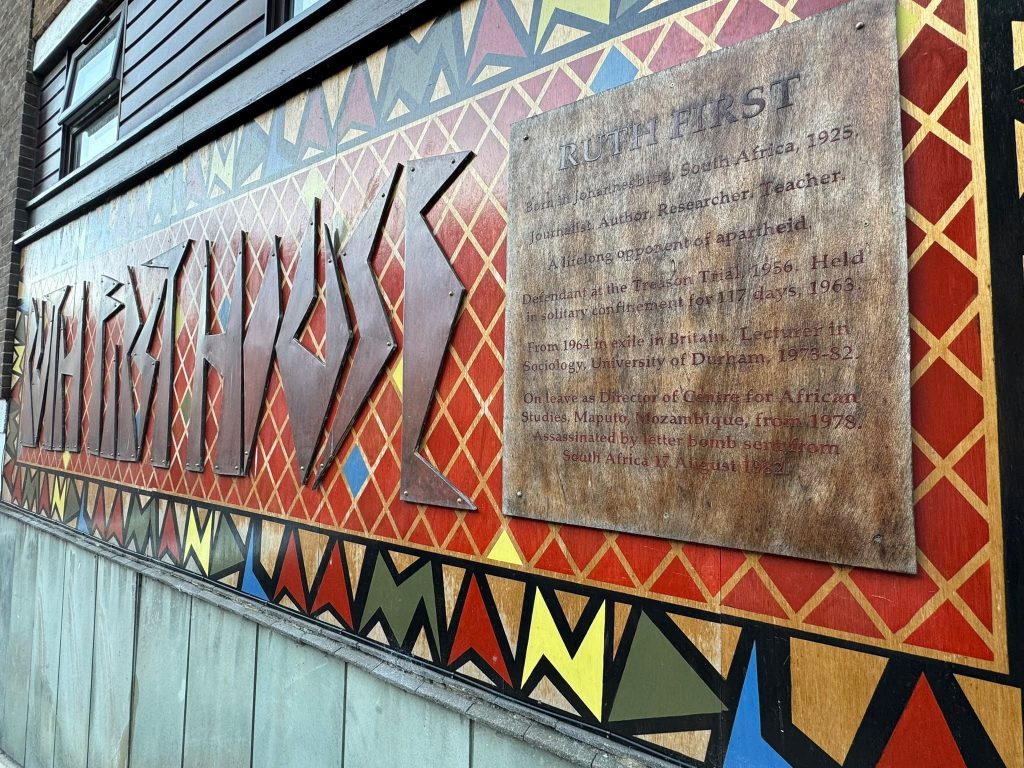
Arguably, the tour’s most hidden-in-plain sight memorial is a plaque and mosaic dedicated to anti-apartheid activist Ruth First, just off Claypath, on what many would recognise as the QStudent accommodation building, just up from the Tesco Express. In fact, named ‘Ruth First House’, the display on this building commemorates First’s place of work during her years spent working at the University. First was a defendant in the 1956-1961 Treason Trials in South Africa alongside Nelson Mandela and members of the African National Congress. After being acquitted, she came to the UK in exile in 1964. First went on to work at the University of Manchester and Durham University, and was an active member of the British Anti-Apartheid Movement. Tragically, First was assassinated by the South African government whilst onleave from Durham working at a university in Mozambique in 1982.
What I never imagined was that the tour would present facets of history that intersected with my own degree and areas of academic interest, principally the history of race and racism in the US. However, I was fortunate to take Dr Liburd’s second-year module ‘Black British History’ last year. In my coursework for this module, I explored the contradictions presented by the ambiguous legal status of enslaved individuals on British shores before the 1833 Slavery Abolition Act. There were two legal rulings pivotal to this history, the 1729 Yorke-Talbot Opinion and Lord Mansfield’s ruling in Somerset v Stewart, 1772; both of which have tangible links to Durham Cathedral. If you go to the board of Bishops in the Cathedral, you will see that the Bishop of Durham, 1721-1730, was William Talbot. Talbot’s son Charleswas appointed Crown Solicitor General in 1726 and co- authored the Yorke-Talbot decision with Attorney General Sir Phillip Yorke. This decision ruled that enslaved individuals were not rendered free by being brought to England or their enslaved workers to return with them to the colonies after visiting England.
This precedent set by the Yorke-Talbot decision was the primary legal basis for slaveholders treating their enslaved workers as chattel property on the British Isles until it was overruled by the Mansfield decision in 1772. In the cathedral cloisters, there is a memorial dedicated to Thomas Sharp, a Prebendary, and some of his descendants and children. Thomas’s son, Granville, who is not commemorated, was a prominent British abolitionist in the mid-18th century. Granville was a key figure backing James Somerset, a West African sold into slavery aged eight, who was brought by his master Charles Stewart from the Colony of Virginia to England in 1769. After Somerset escaped in 1771, he was recaptured and imprisoned on a ship bound for the British colony of Jamaica, where he was to be sold into plantation labour. However, Stewart’s godparents from his baptism in England made an application to the Court of King’s Bench, claiming that this violated the writ of habeas corpus. The resulting case of Somerset v Stewart and Lord Mansfield’s ruling that an enslaved person could not be forcibly removed from England and sold abroad. Abolitionists in England interpreted this as the abolition of slavery on British soil. Although this was not technically true, as it was merely a narrow ruling against forced deportation, this decision set a powerful legal precedent that contradicted judgments like the Yorke-Talbot Opinion and inspired later antislavery movements.
Perhaps slightly more tenuous, there were even some links to my studies of the history of race and racism in the US. The stained-glass Moses Window of the Cathedral depicts Moses’s departure from the Court of the Pharaoh, an image displayed in St. Paul’s Church in Richmond, Virginia, commemorating Robert E. Lee, the Commander of the Confederate States Army during the latter part of the American Civil War. Supporters of Lee in his home state of Virginia drew parallels between Moses’s departure and Lee turning his back on the Union. Following the Black Lives Matter Protests of 2020, St Paul’s rededicated the window to God as an act of reconciliation, and a statue of Lee was taken down in the city of Richmond in 2021.
Whether it be the easily visible, like the Celtic cross or Ruth First’s mosaic, or the quieter yet indelible links of names etched into the Cathedral walls, the presentation of these histories really made me realise the scope and interconnectedness of global histories of racial exploitation. To many, Durham is a small, quiet city tucked away in the North East. However, Palace Green alone has historical links spanning the West Indian colonies of the British Empire, South Africa, and Richmond, Virginia. The absent presences the curators showcased were profound, but more significant than these long-quietened histories are the way in which they interrelate with global Black histories and histories of racial exploitation. Having only dealt with textual resources in my own work, the tour made me reconsider how space and physical objects can relate to these much broader, transnational narratives, even in the places you least expect them to appear. I even got a taste of this myself when doing my dissertation research. I was exploring the denial of Federal aid payments to mothers of dependent children in1960 Louisiana when I came across a very unexpected cameo from the North East.
In resistance to court-ordered school desegregation in 1960, Louisiana’s Governor Jimmie Davis and the state legislature passed a series of laws known as a ‘segregation package’ to undermine federal authority and intimidate Black communities that were starting to accrue incremental gains on the Back of the Civil Rights movement. One of these was to impose suitable home conditions on recipients of federal government-subsidised aid to dependent children payments. These restrictions meant that local officials could deny aid to any mother who authorities deemed to have an ‘illegitimate’ child conceived outside of marriage, amongst other restrictions. The result of these restrictions was that 22,501 children across 6000 families were excluded from aid as of August 1960, 95% of whom were Black.
This is where the North East enters the frame – fifteen angry City Councilwomen from Newcastle organised a ‘bundle from Britain’ which shipped 23 pounds of baby food and clothing as well as money to children cut from relief rolls in New Orleans. Led by Mrs Theresa Russell of Newcastle City Council, the women also organised a campaign titled ‘Shame Governor Davis’ and petitioned the United States Ambassador to the United Kingdom, John Hay Whitney. Their message to Whitney expressed ‘outrage that such a thing could happen in the civilised Western world.’ Historian Lisa Levenstein even credits the efforts of Mrs Russell and co as garnering enough publicity so that the escapades in Louisiana were moved from the back pages to the front pages of the New York Times, giving the issue a national and even international spotlight in the press.
Sadly, there was little more I could find about the Newcastle councilwomen via online archives accessible to me, and given their involvement was somewhat superfluous to my actual dissertation. But this unexpected encounter showed me, in addition to the connections displayed in the walking tour, that history, but especially Black history and the history of race and racism, is pervasive, and its connections are far-reaching. Further, it showed that hidden amongst the absent presences in Durham’s long and complex Black history, there are stories of support and courage, like those of Ruth First and the Newcastle Councilwomen, that exist symbiotically with histories of oppression and injustice. As the walking tour demonstrates, we should question the immediate histories before our eyes and the links to histories even broader in scope, for you never truly know what can emerge from beneath the surface of seemingly innocuous buildings or discreet memorials inscribed in centuries-old stone.
Much of the historical information drawn upon in this article is explained in greater detail on the interactive map for the Durham Black History Walking Trail, which can be accessed via the Durham World Heritage Site website.
Image: Luke Taylor




Leave a comment