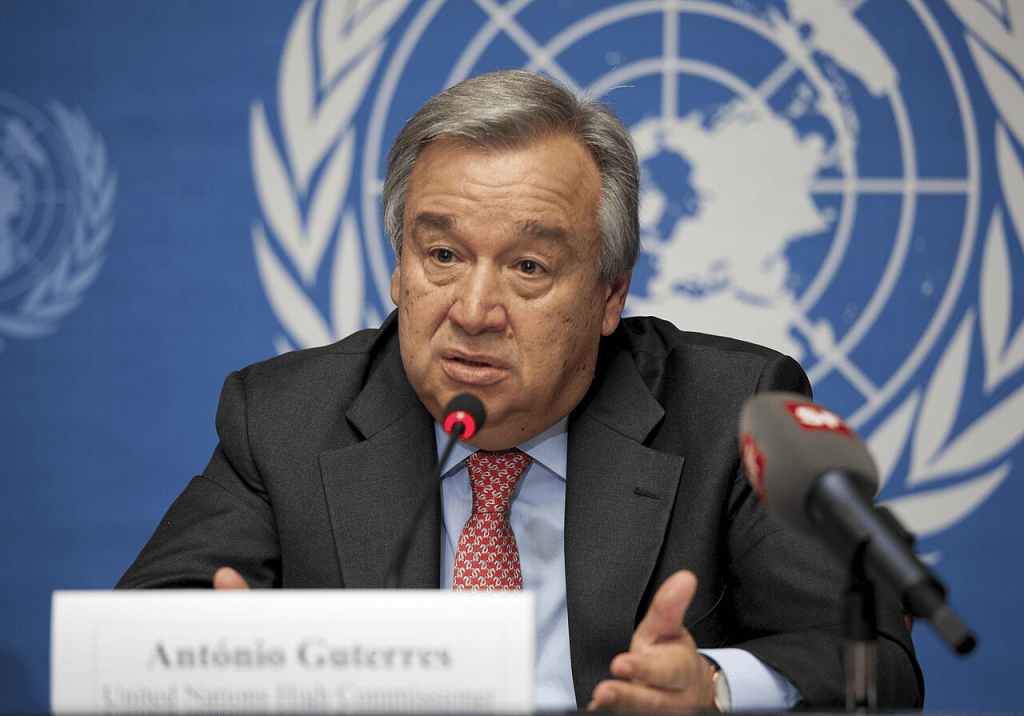
António Guterres leaves the United Nations after almost a decade in one of the world’s most powerful, and most constrained, political positions. In his farewell address to the General Assembly in the last week of September, he issued a warning to those listening: international law is fracturing, global power inequality is increasing, and the institutions designed to resolve conflict are struggling to keep up. His assessment of the past decade was hardly a victory lap, ultimately concluding that the ‘fault-lines’ in our world are widening.
International law is fracturing and global power inequality is increasing
The effectiveness of the UN as a whole has been widely criticised for decades, not least by Guterres himself, and therefore his less-than-positive reflections come as no surprise to anybody critically appraising the events of the last 10 years. With more than 65 active armed conflicts happening worldwide according to the Council on Foreign Relations, what is the practical use of the UN? Leadership across the world has called for harsher sanctions to be placed against transgressive states, only for such justice to be vetoed by the political interests of the permanent members of the Security Council. The limits of this power were particularly visible during the March 2024 US-sponsored resolution calling for an immediate and sustained ceasefire in Gaza and both China and Russia exercised their vetoes to block the motion. Episodes such as this illustrate the fundamental contradiction at the heart of the UN: it is expected to enforce international law, whilst its most powerful decision-making body remains dependent on the political agendas of its permanent members. Whilst majority of resolutions (30 out of the 46 in 2024) were agreed unanimously, the effectiveness becomes far more uncertain when the political interests of its permanent members collide.
But this raises a more fundamental question: what should we actually expect the UN to achieve? The UN is expected to uphold international law, despite lacking the powers of a conventional government to enforce it. In his preparations to leave office at the end of the calendar year, he emphasised the importance of limiting the hegemonic tendencies and habits that have arisen from the General Assembly over the last half century. Guterres recognised that neither military nor economic power alone can guarantee stability. Instead, the UN must adapt to a world in which power is increasingly redistributed both between and within states.
What should we actually expect the UN to achieve?
Despite the widescale conflicts, both armed and unarmed, happening at this moment in time, the United Nations has had practical use in opening the necessary channels to begin enforcing international law upon states accused of violating another state’s rights. Measuring its effectiveness solely by whether it can stop wars misunderstands what the organisation is capable of doing. Its greatest power may no longer lie in enforcement, but in legitimacy, naming violations and creating diplomatic pressure that allows weaker states to have a platform to challenge more powerful ones.
Over the last decade, we’ve seen strong attempts to sanction states directly infringing upon the rights, sovereignty and culture of others. While these are often blocked by various members of the Security Council, they do signify a step in the right direction. Even a direct recognition of a crime under any name is progress, and in a world where soft power is becoming increasingly important, such recognition holds weight on an international stage. The UN’s decade-long mission in Mali demonstrates this more complicated form of effectiveness. Even if it ultimately failed to create lasting stability and was withdrawn in 2023, the mission supported political dialogue, elections and ceasefire negotiations. The UN cannot manufacture peace, but it can create the conditions in which political solutions became possible
Over the last decade, we’ve seen strong attempts to sanction states
In an era of increasing global polarisation and severe humanitarian crises, the ability to expose and document violations of human rights and international law remains valuable. This may be one of the UN’s greatest advantages: it can give international recognition to abuses that might otherwise go ignored. The next Secretary-General therefore faces an impossible contradiction: leading an organisation expected to prevent conflict while lacking the power to force its most powerful members to act. Guterres’ farewell does not prove that the UN has failed. Instead, it exposes the limits of the modern capabilities of the organisation, while reminding us that in an increasingly fractured world, having a forum for international accountability is more valuable than ever.
Image credits: Eric Bridiers via Wikimedia Commons




Leave a Reply