An interview with Trevelyanite and Goalball player, Andrew Hamilton
SM: What is Goalball?
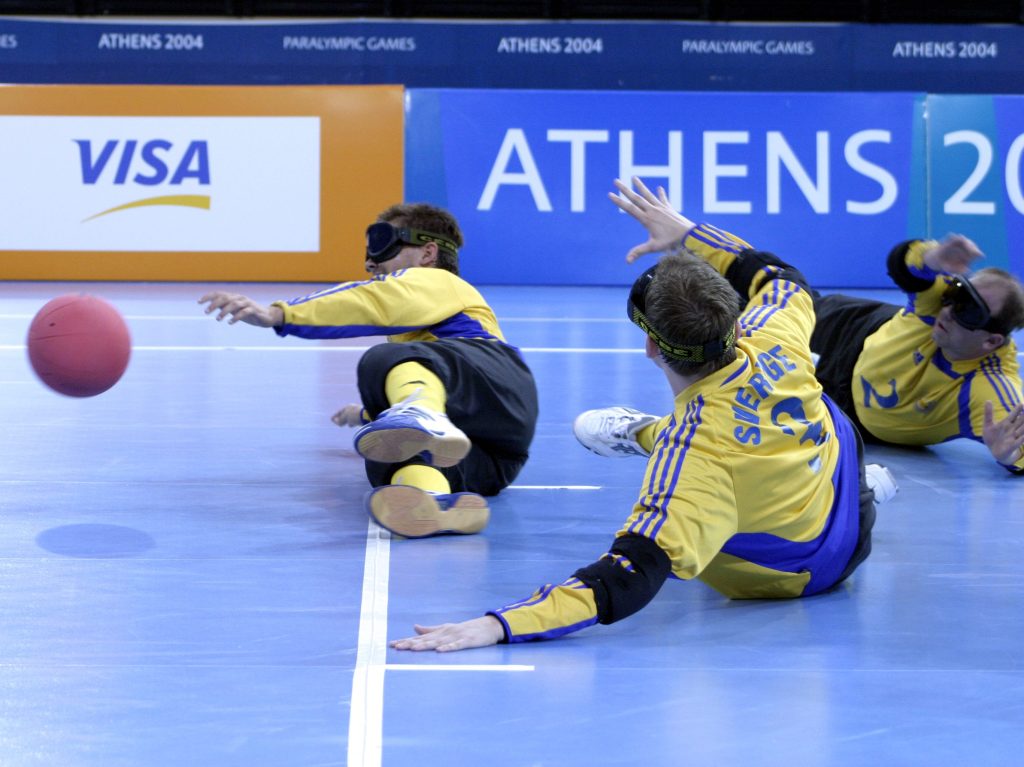
AH: Goalball is a team-based sport played by those with visual impairments. It is played on an indoor volleyball court, with tactile floor markers and nets at either end that span the width of the court. Players wear blackout eye shades, throwing or rolling a goalball (a basketball-sized audible ball) into the opponent’s goal. Relying on hearing and touch to navigate the court, players defend and ensure ball throws remain legal through hitting various zones on the court.
Each team fields a centre and two wing players, who play both offensively and defensively, diving and using their bodies to block the ball from entering the net. When the ball is in play, the game is played in complete silence to allow the defending team to track the ball audibly. This concentration and silence are necessary because defensive movements are made at an extremely fast pace, often within a split second. Communication is also an essential element of the game. Although there are only three players per team on court at one time, we are often running around other teammates to vary the position and angle when throwing during possession of the ball.
A game’s duration can vary depending on the level of competition, from 8 minutes up to 24 minutes, split into two halves. Whilst this may seem a relatively short timeframe, on court it feels like a long time and is best described as the same intensity of basically doing near constant burpees on court!
Originally designed as a rehabilitation activity for veterans after World War Two, Goalball has evolved into a popular and significant sport amongst the visually impaired. Today, the sport is played worldwide, from club and domestic level, right the way up to international and Paralympic level.
Goalball has been a rewarding experience in seeing myself and teammates improve.
SM: How did you get involved?
AH: I am from Northern Ireland and before coming to university, adaptive and disability sports were basically nonexistent. When I came to Durham, I was connected with a couple of other visually impaired students from the university who played Goalball with a club, Northern Allstars in Newcastle. I attended my first training session in May 2025 and immediately became obsessed.
Since getting involved, I have begun to play in Goalball UK’s region A league. This is a regional league that has tournament match days throughout the year for Northern Allstars. Throughout the year, I have contributed to the regional team’s success, with particular mention to tournaments 1 and 3, in which we placed 2nd and 3rd respectively. Overall, we had a fairly successful season, finishing 3rd overall in the league. To end off this season, I have the goalball UK shield competition in the coming weeks, in which I will be playing against other regional teams from all over the UK.
SM: It sounds like Goalball is both demanding and rewarding, then?
AH: I train, roughly, on a monthly basis in Newcastle on a Saturday; training is often intensive as it usually lasts most of the day. In fact, I’m often battered and bruised for multiple days after! Whilst it is a very physically and mentally demanding sport, which is surprisingly very complex, with a steep learning curve, it has been a rewarding experience in both seeing myself and teammates improve over the past year. It often ends up being the highlight of my month, both from playing and training with teammates, but also the social aspect within the club.
It is also an ever-welcome break from my ever-increasing workload, both academically and extracurricular workloads at Trevs. Besides this, I love being on an equal playing field and being able to get fully immersed in a sport specifically designed for visual impairments. As opportunities for sport, particularly within university is often more limited for disabled students, I hope this article has given a unique insight into the sport which I have so much passion and enjoyment for.
Image: Helene Stjernlöf via Wikimedia Commons


Leave a Reply