
I’m an archaeologist. I deal in material culture, bones, radiocarbon dates, and such to understand the past. When I heard that Philippa Langley, the discoverer of the supposed burial of King Richard III, was coming to Durham, I knew I had to be there. It’s a brilliant story, both of his life and his discovery, neither of which remains unmarred by controversy. The skeleton could be Richard III, but nothing proves it is. Some of the isotopic and bioarchaeological conclusions are debated; to learn more, see Lamb et al. (https://doi.org/10.1016/j.jas.2014.06.021) and the response in Prokipis 2025 (https://doi.org/10.1080/13642529.2025.2480991), a personal favourite of mine. There was also a lawsuit over the production of the film The Lost King, based on the discovery of the body.
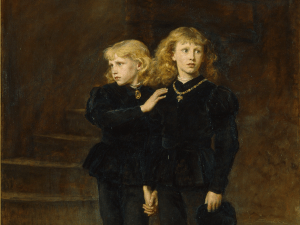
But Richard III was not what Langley came to Durham to speak about. Since her last discovery, she has moved on to new pursuits: uncovering the truth about the Princes in the Tower. Langley got involved with the Richard III Society because she did not feel that Shakespeare’s depictions of him as a cruel, hunchbacked monster were backed up by any reality other than King Henry VII’s propaganda. Yet one of the enduring stories about Richard’s cruelty is the supposed murder of his nephews, King Edward V and Prince Richard of Shrewsbury, to consolidate his power and quell any dissidents.
Langley points out two things. First, Richard III had very little to fear from these two children, who were legally considered out of succession by an act of parliament. Still, Henry VII would have feared them as he technically reinstated their claims, and the Princes were adults for most of his reign. Second, there are no contemporary accounts of the princes’ disappearance, and the Tudor propaganda machine was quite strong. The story we have today comes from St Thomas More, who may have fallen out with Henry VIII, but still served him faithfully for many years before, including when he wrote this account.
One of the enduring stories about Richard’s cruelty is the supposed murder of his nephews, King Edward V and Prince Richard of Shrewsbury
This kind of distrust and the dismantling of history and historiography are familiar to me. We do it all the time in archaeology, as we try to make sure our interpretations of the physical material culture are not constrained only by what people have written before us, which we all know can be biased. But what I found so interesting was how Langley dug herself out of this dark hole, enlightened by no mainstream documentary sources, she went back in.
The supposed bones of the princes are in an urn, buried in Westminster Abbey by King Charles II after they were discovered in 1674. I remember being 10 at the Tower of London and hearing this story—a bit bone-chilling at that age. The urn was opened in 1933, and the bones were confirmed to be of the right age, but the investigation was brief and presupposed the conclusions it eventually reached. Recent petitions to open this urn, and the two skeletons of children found in St. George’s Chapel, Windsor (which are unidentified), have been denied by the royal family. DNA, radiocarbon, modern skeletal, and isotopic studies, as done to Richard III, could help shed light on the issue, but as of now, the bones say very little. I am not arguing that the bones necessarily should be opened, as DNA, radiocarbon, and isotope studies are destructive, and even if the bones are royal and from the right period, we still cannot find out how they died. Archaeology tends to deal with larger research questions than just ‘are these bones real?’ and to perform destructive analyses, so there needs to be a clear research objective.
It is worth noting that, legally, bones this old would not require the permission of living relatives if they were not alleged to be royal, as the royal family has special permissions to block academic research if they so wish.
However, Langley doesn’t believe these bones are legitimate. She led the Missing Princes Project, which scoured the archives of Britain and the Continent for any references to the young princes. Much of it was found in likely very boring texts, like receipts from Emperor Maximilian I of the Holy Roman Empire. Still, it gave fascinating insights, such as Maximilian giving 100 pikes to Margaret of Burgundy, aunt of the princes, to support their cause.
We try to make sure our interpretations […] are not constrained only by what people have written before us, which we all know can be biased. But what I found so interesting was how Langley dug herself out of this dark hole, enlightened by no mainstream documentary sources, she went back in.
One of the most interesting things I learned at this event was that pretenders launched military campaigns for the throne, both of which were ultimately unsuccessful. Each one claimed to be one of the princes, but was discredited as a commoner by Henry VII. Langley discovered that all correspondence, be it attributed to the princes themselves, with their seals, Margaret of Burgundy, or others on the Continent, referred to them exclusively as being real, not pretenders. If we return to the idea of the Tudor propaganda machine and the fact that Henry VII reinstated the princes’ claims, we can see where the pretender narratives come from.
While this evidence is interesting, I disagree with Langley here. I think that the evidence could go either way. Propaganda is certainly here, but it need not be just Henry VII. Maximilian I would have described the prince-pretenders as legitimate, lest his accounts be intercepted or seized—a fact we have to take into consideration with his blocked coronation attempt, and his own propaganda about himself. Margaret and the pretenders themselves had everything to gain from being seen as legitimate, no matter their real bloodlines. She also argues that royals of Europe would not take this risk on a commoner, as their bloodlines were ‘sacred’, but I feel this line of reasoning ignores so much of real power struggles, greed, and desires to have allies or patsies on foreign thrones, and assumes the nobles to be overly concerned with religion and blood over reality.
However, her arguments do have merit. We must remember that history is never solved, just more information added to an ongoing conversation. What makes Lagley’s work so important is the historical orthodoxy it challenges—especially on a topic with evidence to light. We need more challenges. And archaeology’s comb is far too wide-toothed to answer this question, which is why the uncertainty over Richard III remains, and opening the urns may not prove anything, so history is a very valid approach. It always amazes me how archaeologists and historians can study the same topic so differently, even when they integrate one another’s evidence.
If this interests you, Philippa Langley has just released her full case in a new book: The Princes in the Tower: How History’s Greatest Cold Case Was Solved.
Image: Painting by John Everett Millais, Photograph by Royal Holloway Art & Culture via Wikimedia Commons

 HEX
HEX 
Leave a comment