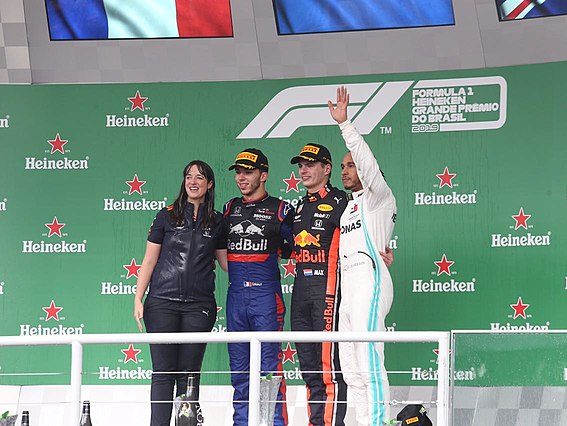
Formula One (F1) is a male-dominated sport. Throughout the sport’s 76-year history, only five women have entered a Grand Prix. The last of these five women participated in 1996. Management and the pit lane also face a similar problem. Monisha Kaltenborn and Claire Williams are the only women to have led an F1 team. If you turn on F1 on your television, you will undoubtedly see more men. However, this sharp disparity in the sport is quickly changing.
Over the last decade or so, more and more women have entered the world of F1. We have also seen a large increase in female fans. This Sunday, 8th March, is both International Women’s Day and the Australian Grand Prix. In celebration of Laura Müeller and Hannah Schmitz, and women in STEM, turn 6 of the Albert Park Circuit will be named after the two as part of the ‘In Her Corner’ initiative. This piece will discuss these two women, and others working in and around F1 today, their roles and the impact they have.
Laura Müeller
Laura Müeller is from Germany and studied Automotive Engineering at the Technical University of Munich. After extensive experience in various motorsports categories, she entered the world of F1 in 2022 with Haas as a Performance Engineer. In 2025, Müeller was appointed to the role of Race Engineer for one of the team’s drivers, Esteban Ocon. She is the first female race engineer in the history of the sport.
The role of a race engineer is extremely important in F1. Race engineers are responsible for many aspects of a race weekend but their main role is to act as the point of contact for a driver during a race, linking them to the wider team. They work to improve car and driver performance through conversing on car setup, data, strategy and other aspects. Müeller is a central influence on the performance of Ocon.
Müeller’s position as the first female race engineer in F1 is significant for female fans of the sport, especially for young girls who may aspire to a career in motorsports. Race engineers are becoming increasingly more visible as F1 broadcasts feature radio messages between drivers and their engineers during races. The centrality of this role and Müeller’s skills are a testament to her importance to the world of F1 and an inspiration to those who wish to break down barriers in a historically stagnant sport.
Hannah Schmitz
Hannah Schmitz is from England and studied Mechanical Engineering at the University of Cambridge. She entered the world of F1 in 2009 with an internship at the Red Bull team. Throughout her impressive career, Schmitz has remained with Red Bull in numerous roles, from a Modelling and Strategy Engineer to Senior Strategy Engineer to Principal Strategy Engineer and finally, as of this year, Head of Race Strategy.
Schmitz is renowned for her skill in strategy, a crucial area of F1 which can make or break a driver’s race. This was most evident recently at the 2025 Qatar Grand Prix when Schmitz made the decision to pit Max Verstappen, contrary to the choice of rival team McLaren. This decision paid off, and Verstappen went on to win the race because of the pitstop, bringing him even closer to a potential fifth championship. Schmitz’s strategy decisions have also led to a number of other wins for Red Bull. Her contributions have led her to stand on the F1 podium twice to accept the constructors’ trophy, making her one of only eleven women to have done so.
Schmitz’s skills and intelligence in strategy act as another point of inspiration to young fans of the sport. She is often seen on broadcasts on the pit wall, and her presence and success prove that women can thrive in so many different aspects of F1.
Bernie Collins
Bernie Collins is from Northern Ireland and studied Mechanical Engineering at Queen’s University Belfast. During her university years, she joined the annual Formal Student program and later joined McLaren as part of a training program. After graduating in 2009, Collins transferred to McLaren’s design department. Her progression in the sport continued rapidly after. In 2012, Collins was promoted to the role of Performance Engineer. She left McLaren in 2015 to join the Force India team as a Performance and Senior Strategy Engineer. Collins stayed with the team through its name change to Aston Martin and was Head of Race Strategy from 2020 to 2022. She was a strong influence in many of the team’s successes throughout her years there.
Collins switched careers in 2022 and joined F1 TV as an analyst before moving to Sky Sports the next year. She remains part of the Sky commentary team to this day. Her impressive background in the technical side of F1 has made her an impressive and informative addition to the commentary side of the sport. Collins’ wide involvement in many sectors of F1 shows how jobs in F1 are beginning to diversify and open to many types of people.
Susie Wolff
It would be a disservice to talk about women in the world of F1 and not mention at least one driver. Susie Wolff is from Scotland and was a professional racing driver. She began in karting and competed against the likes of Lewis Hamilton. Wolff gradually rose through the ranks of junior categories until she was signed by Williams in 2012 as an F1 Development Driver. In 2014, she participated in a practice session at the British Grand Prix, making her the first woman to take part in an F1 race weekend in 22 years.
Wolff retired from racing in 2015 but has continued to be involved in motorsport in a number of ways. She has been an analyst for F1 TV coverage and a Team Principal in Formula E. Wolff’s most recent venture in the world of motorsports is as the Managing Director of F1 Academy, an all-female development racing series.
Wolff’s work in F1 Academy strives to create a future in which more women enter the world of motorsports and F1, with an eventual aim of seeing a female F1 driver. In her time as Managing Director, she has launched many initiatives with the series that aim at inspiring and supporting the next generation of women in motor racing. The series is still in its early days, but interest and involvement by girls in the lower levels of the sport, such as karting, has begun to increase. Wolff’s work, and the work of F1 Academy itself, is crucial to ensuring a more diverse future for motorsports.
Even though this piece has only covered four women from the world of F1, there are so many other talented, driven and skilled women who are working in every aspect of the sport, from engineering to mechanics to commentary to media and more. As motorsports continues to diversify, it will be exciting to watch which other prominent figures will emerge and how the demographic of F1 will change.
Image: Governo do Estado de São Paulo via Wikimedia Commons



 HEX
HEX 
Leave a comment