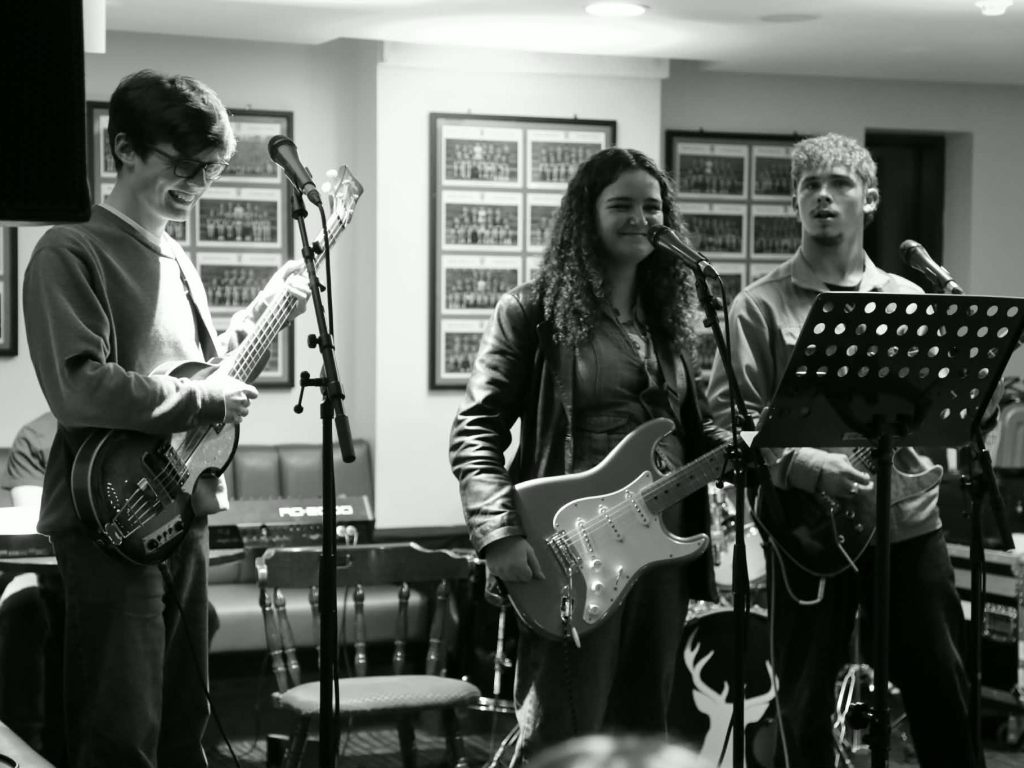
Michaela Ashworth is a second-year Combined Honours in Social Sciences student who studies Spanish, Politics, and Sociology. Michaela is a musician, songwriter, member of two bands, Co-president of Queer Sphere, and also plays for Trevs-South women’s football team.
LT: One of my first memories of you is when you performed at your Freshers’ Week Unplugged, and I was really impressed by the song you performed in Spanish. Tell me about your love of Latin American culture and about the time you spent there on your gap year. Where did the musical influence come from?
MA: Yeah, I actually was really obsessed with it [Latin American Music] before travelling. That was part of the reason why I went on my year abroad. I was in a Latino band at school, and I was actually obsessed with it. It consumed a lot of my thoughts, but it was like no one else was thinking about it. But I really, really, really loved the music in it. We did a lot of like Buena Vista Social Club and just a lot of kind of salsa Afro-Cuban jazz, that kind of stuff. I played the trumpet, and I sang, and I was just so obsessed.
I wouldn’t play the guitar a lot at that point because I was still teaching myself. I was doing Spanish A-level, and I just really liked Spanish. So I learned a bunch of songs, and it really helped with my Spanish, and then it kind of inspired that trip […] I worked in a music centre at one point, doing a lot of Argentinian music, which was cool. I spent around a month in Cali [Colombia], which is the salsa capital of the world. I was not a very good dancer at all. I really tried with the dancing; I spent a fair few hours trying to learn how to dance. But the main appeal of the salsa bars was all the music. It was beautiful dancing, but also, you would often go, and it would be live music. It was amazing.
[…] In Mexico. I was working in a hostel, doubled up as an events organiser, and I made a couple of Argentinian friends who were really into music. We did quite a lot of collaborations and stuff like that, and we put on a music event. It was really nice. So yeah, I learned a lot about Latin American music. I really liked the mariachi stuff in Mexico as well; I was a big fan.
LT: What would you say was the biggest thing that left an impression on you from your time in Latin America?
MA: It’s kind of hard to put into words. I was reflecting on this the other day because we had a Spanish class on the different personalities that you have in different languages. I think it’s not even just the culture. It’s also speaking Spanish the whole time. I feel like it just made, I know, this is going to sound really cringey, but when you speak Spanish, it’s often a lot more fluid, and you can be a lot more affectionate than in English. That probably is it, becoming a lot warmer, more affectionate towards people.
LT: Let’s talk about music. You play guitar, trumpet, cello, and you sing. Tell me how all of that came about.
MA: I don’t play trumpet anymore, or the cello. I had a mental block with the trumpet, and then playing the cello was just because I had to do it at school. I didn’t particularly enjoy the trumpet or the cello […] Guitar has been really great because I taught myself, and I can do whatever I want without being told what to do, and I don’t have any pressure on me. It’s been really nice just to do exactly what I want to do, which is the Spanish stuff. I recently started writing songs, which is really nice because there’s literally no structure to it at all; it’s just doing exactly what I want.
‘Guitar has been really great because I taught myself, and I can do whatever I want without being told what to do, and I don’t have any pressure on me’
LT: Talk to me about songwriting.
MA: I only started writing songs over the summer, and I was not very confident with it at first. I really wanted to write songs for ages, but I think I had too much of an ego with it. I just wanted to write something good, and then it stopped me from writing because I just felt like everything I wrote would be bad. Then I got over my ego, and starting was really hard; getting the process down is really hard at the beginning. There are no building blocks to work off, you’ve just got to find out what works for you.
I’m still pretty new to it. I’ve only written like 9 songs or so, but I think I’ve got it down a bit more now. Normally, I start with an emotion or some lyrics or an idea, and then I do different things with different songs. Sometimes it just comes out if the emotion is there. But then sometimes I’ll write a few chord progressions, and then I’ll pick the one that matches the most. I often find that if I’m singing lyrics, because I kind of write the lyrics first, and then I sing them on top of the chords, then it’s just whatever comes out comes out. So I feel like the way I sing it often does reflect more of the emotion, but it’s still something I’m working on
LT: Were you ever scared of the ‘putting yourself out there’ side of songwriting and then performing these songs?
MA: Never. You’ve got to not care what people think. I also think it’s good to write songs just for yourself. Over Christmas, I stopped writing songs, and I was like, I’m not doing any more open mics because I found that I was sometimes writing songs with an audience, and what they’d think, in mind. For example, maybe I’d be less vulnerable with lyrics or it wouldn’t quite match up with what it meant for me, if that makes sense.
For example, lyrics are obviously quite personal. And I’m not a particularly poetic person. I’m getting better, actually, but my lyrics are right on the mark, so people know exactly what’s going on in my life from my lyrics. Sometimes, if there was something that I would be upset about and I wanted to write a song about it, I’d try to make it more abstract, or I wouldn’t want to write about it because I knew I’d then perform it, so I would try to write about something else. I just didn’t feel quite authentic enough.
LT: Tell me about your bands.
MA: The main one is Chilli Knees, the one that I have with Seb Powell, Henry Wheatley, Ben Patten and Gabriel Tucker, or H. Bomb, as he is otherwise known. Basically, Seb and I made a band last year, and we decided that the band could never get anything together, we were bad at rehearsing. People weren’t committed. So we auditioned people this year because we wanted to do function gigs. We’re doing Julius Caesar [with DST] in March, which is really exciting. It’s heavy metal over the top because they’re doing an ‘80s version. We’ve been doing quite a few gigs recently. It’s really great, the band has such good vibes, and it’s honestly really good. Everyone’s really talented, I’m kind of the worst in the band, which is great, as in, because everyone else is so good.
The other band is the Franklin D. Roosevelt band, with Joe Whitehill, Elena Eyres, Jake Remus Elliot, and Ben McKinlay. We do all originals for that one; the band is a bit of a mess on purpose. Elena started learning the bass a week before we made the band. So the point is, we just kind of go with what we’ve got; it’s more about feeling and creativity. A passion project. It’s so fun to have an hour of pure creativity every week. It’s half Joe’s songs, half my songs, and it’s really fun.
‘I really wanted to write songs for ages, but I think I had too much of an ego with it. I just wanted to write something good, and then it stopped me from writing’
LT: Tell me about your involvement in starting up Queer Sphere.
MA: Yeah, it’s been a lot. It was just me and Meg Thomas, the other president, and we didn’t have an executive for the first few weeks, so we were doing every single thing between us. We’ve got a nice exec now who are really good.
[…] It’s really nice to contribute to local activism; we’re organising pride alongside the local community. We’ve been trying to get the different prides to work together a bit more, because it’s quite fragmented. Obviously, the students don’t go to the Durham Pride as much. We work mostly with Durham Pride, and we did a fundraiser for them last term because the funding got slashed by reform. There are lots of different prides in Durham: Durham Pride, Hill Pride, Bailey Pride, and also a grassroots one this year, because the main one is very corporate.
We’ve also done an open mic, a music event fundraiser, film screenings, a couple of academic talks, and a bunch of socials. We’re doing a Fabs collab at the end of term. People were missing it, because there wasn’t one [a university-wide queer-representing society] last year, and attendance has been pretty high because of that. We did our first social, and we weren’t expecting that many people to show up, and then like fifty people showed up and kept coming back.
LT: Let’s talk about Trevs-South women’s football. How have you found it starting a new sport at uni?
MA: I like football because it’s fun, the people are nice, and it’s good exercise. It’s good to learn something new. I feel like football is one of those things that’s really useful. It’s a useful skill to have, I feel like, because it’s always there to play. I don’t like being bad at things, so that’s been a bit of a struggle because I’m not very good at football. I got better, though. I did score in the last round of Floodlit, but I think it was a bit of a fluke, to be honest. It was my college daughter passing the ball because I had to score a goal, and the goal was open. I’m working on it. Maybe in my fourth year, I’ll come back and be a defender, and then I won’t be so bad if I can’t score a goal! I don’t bring skill to the team, but I feel I can bring the energy.
LT: What does Trevs mean to you, and what do you think you’ll take with you from Trevs in the future?
MA: I’m a big fan of Trevs now. I was pretty neutral about it at the beginning, but especially 2nd year, I’ve been a big fan of it. Mostly because of the music. I think this year I really realised how good it actually is for me, doing Live on the Hill was the best thing ever, and all the Unplugged. I feel like I really wouldn’t have gotten stuck into music nearly as much if I hadn’t been at Trevs. And everyone’s so supportive in the music, I feel like I’ve learned so much.
Definitely the people. I feel like Trevs has definitely got a quirky vibe, which is my favourite kind of vibe. My friend group is deeply, deeply odd in a good way. We were talking about it, about how everyone is just deeply, deeply odd. I got voted top 3 most normal, which is crazy. Everyone feels very unique, and everyone’s so friendly, and it’s just a nice vibe and a nice community feeling.
Chilli Knees Instagram: https://www.instagram.com/chilliknees/
Cover image: Michaela Ashworth

 HEX
HEX 
Leave a comment