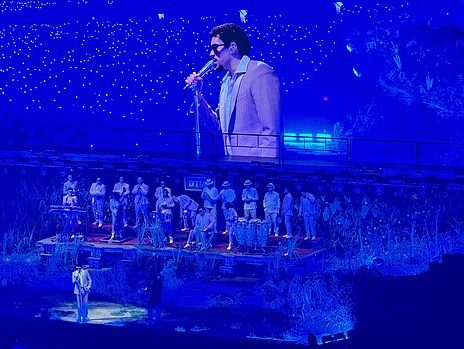
128.2 million people tuned in to watch Bad Bunny’s Superbowl halftime show this year, and on social media this performance broke records, getting over four billion views in just twenty-four hours. The Puerto Rican artist came to the Superbowl stage with a simple, clear message: unity over division, love over hate. However, considering the huge reach of this performance, some have taken to social media to criticise Bad Bunny’s lack of explicit political messaging, especially in the wake of the violent crackdown on immigration in the US. I want to pose the question: to what extent should we be expecting celebrities to make grand political gestures? Is the line between celebrity and political figure becoming blurred? Or is this all a symptom of one-sided, parasocial relationships with artists?
For better or for worse, it would be naïve to deny the immense influence that celebrities wield in the current political climate. According to a recent study by Ofcom, half of adults in the UK get their news from social media, rather than traditional sources such as radio, television or newspapers. This shift is part of a general trend of growing mistrust towards institutions, with many looking towards their favourite influencers and artists to inform their politics. Celebrity endorsements can make or break a political campaign: when Taylor Swift encouraged her fans to register to vote in US legislative elections back in 2023, Vote.org saw a 1,226% jump in traffic on their website. Furthermore, many see the artists they support as an expression of their own identity, and therefore they expect these artists to reflect their moral and political values. After the 2026 Grammys, droves took to social media in support of artists such as Olivia Dean, who used her acceptance speech to advocate for the benefits of immigration, citing her own family history. However, this tendency can devolve into parasociality, as artists can feel pressured to consistently speak up on issues and use their influence ‘for good’, whilst perhaps not being the most qualified to do so.
Many see the artists they support as an expression of their own identity
After all, celebrities are not politicians. Whilst I acknowledge the overlap between art and politics, the role of a celebrity is primarily an entertainer, not a political organiser, let alone leader. Celebrities should advocate for the causes that matter to them, such is the case with Dean and immigration, but perhaps it would be better to turn to seasoned political commentators for nuanced critiques of current situations. The last decade is littered with political missteps from celebrities, from Kelly Osbourne’s infamous quote about Latino immigrants to Charli xcx’s misguided affirmation that ‘kamala IS brat’ in an endorsement of the 2024 US presidential candidate.
Celebrity activism also appears to be a double-edged sword, where both speaking out and staying silent can have massive repercussions. Any advocacy is immediately assumed to be performative; many celebs sported ‘ICE OUT’ pins at the 2026 Grammys which fans ridiculed as being tiny, meaning celebrities must juggle an expectation to speak out and accusations of making advocacy a part of their brand. Ironically, this all serves to divert attention away from the issues themselves and towards the celebrity reaction, raising the question: to what extent is celebrity activism even effective for raising awareness? ‘The Celebrity’ is ultimately a product of branding, they exist to sell things to the masses: can such a figure be an effective activist?
Celebrities must juggle an expectation to speak out and accusations of making advocacy a part of their brand
If we return to Bad Bunny’s Superbowl halftime show, I argue that it is a perfect demonstration of what celebrity activism can be. Bad Bunny has not been shy about his politics in the past: he has routinely advocated for Puerto Rican interests, and he began his own Grammy acceptance speech this year with ‘ICE out’. Throughout the halftime show, it is clear for what and for whom Bad Bunny stands: the performance is almost exclusively in Spanish, and there are references to the legacy of colonialism and slavery in Puerto Rico. Bad Bunny didn’t need to make an explicit comment denouncing Trump or ICE, instead he chose to make his halftime show a joyful celebration of Pan American unity, redefining what ‘America’ can mean. The halftime performance is therefore a demonstration of how celebrity activism can unite art and advocacy in a powerful expression of resistance through joy.
Image: Comecoquito via Wikimedia Commons
 HEX
HEX 
Leave a comment