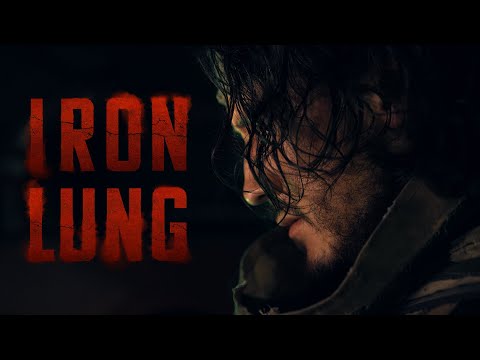
The debut film of Mark Fischbach, better known to millions as Markiplier, Iron Lung is proof that a video game adaptation can be made with actual care when the people involved love the medium, love the game, and are working with a small, committed budget rather than a corporate checklist. It is not trying to be prestige cinema. It is trying to be dread. It mostly succeeds.
Based on the cult horror game of the same name, Iron Lung keeps the game’s core sadism intact: you are sealed in a tin coffin with no external view, forced to infer reality from instruments, noises, and failure. The submarine does not give you a window. The film does not give you a comforting overview. Most of the horror is built from “tells”, the small wrongnesses that accumulate until your brain starts filing everything under imminent disaster.
Based on the cult horror game of the same name, Iron Lung keeps the game’s core sadism intact
That is where the film is genuinely good. The failing pressure gauge becomes a character. The noises in the pipes stop reading as ambience and start reading as intent. You begin to listen for the shift in the hull’s tone, the slight change in a mechanical rhythm, the moments where silence arrives a fraction too cleanly. Even the blood outside changes slowly, almost imperceptibly, and the film trusts you to notice. This is not the jump scare flavour of horror. It is the engineering flavour. The horror of systems, thresholds, and numbers that quietly stop behaving.
The adaptation choice is bold because it stays faithful to the game’s limited information structure, then stretches that structure to feature length. The original game is roughly an hour. This film is two. You feel that extension. There are stretches where suspense becomes so prolonged it borders on indulgent, and you can sense a tighter cut hiding inside it, tapping politely from behind the wall like “hello, I live here too”. Still, it is not padding in the cheap sense. The stillness rarely feels pointless. It feels like being trapped with time itself, watching the minutes thicken.
Crucially, the film understands that the lack of context is part of the experience. Some events land as if out of nowhere if you have not played the game. But that is also true on a first playthrough. The point is not that you should understand. The point is that you cannot. The dread is built from unknowing, from being denied the outside world, from having to interpret threat through partial signals. In that sense, moments that might look like missing exposition are actually the film refusing to grant you the very knowledge the protagonist does not have.
It feels like being trapped with time itself, watching the minutes thicken
When the camera does flash outside, it hits hard because it has been withheld. Those glimpses are not relief. They are punishment. The “outside” is not a vista, it is a reminder of scale, distance, and how little your body and your machine matter to whatever is out there. The film uses those flashes like a pulse of cold water, then locks you back in the box.
Fischbach’s direction is confident without being showy. The craft is in control. The sound design does constant quiet violence. The scrape of metal has texture. The hum of machinery becomes a heartbeat you cannot escape. The whole film is built to make you pay attention to small things, which is a risky ask in a cinema, and yet it works because the details are the threat.
What also works is that the physiological panic feels real. The drops in pressure and oxygen do not play like a game mechanic. They play like a body problem. The dread is not just ‘if I fail, I lose’. It is ‘if I fail, I cannot breathe’. Mark’s performance sells that, not as melodrama, but as a slow tightening, a constant recalibration of fear as the environment becomes less survivable.
Then the film breaks its own quiet.
The ending has a level of blood and gore I have rarely seen outside Evil Dead, not because it is trying to be edgy, but because it commits fully to consequence. After two hours of tension built from gauges and noises, the release is not polite. It is abrupt, overwhelming, and earned, like the film has been saving up brutality and cashes it all at once.
After two hours of tension built from gauges and noises, the release is not polite
The best compliment I can give Iron Lung is that it never feels like a ‘creator project’ in the pejorative sense. There is no wink, no detour, no tonal wobble. It is focused. It is small on purpose. It feels closer to micro budget horror than franchise cinema, which is exactly why it works. Adaptation here is not expansion. It is translation.
This will not be for everyone. If you want constant narrative escalation, you may find it punishing. If you are impatient with procedure, you will feel every minute. But if you understand that dread is built from the slow accumulation of wrong details, Iron Lung is controlled and nasty in the right way.
It seals the hatch, denies you the outside, and makes you listen to the pipes. If this is what Fischbach chooses to do next, mainstream cinema may want to stop sneering at the word ‘YouTuber’ and start paying attention to what happens when someone with an audience decides to use it to fund a nightmare.
Rating – 3.5/5
Image: Mark Fischbach via https://ironlung.com/




 HEX
HEX 
Leave a comment