Content warning: this article contains graphic injury detail
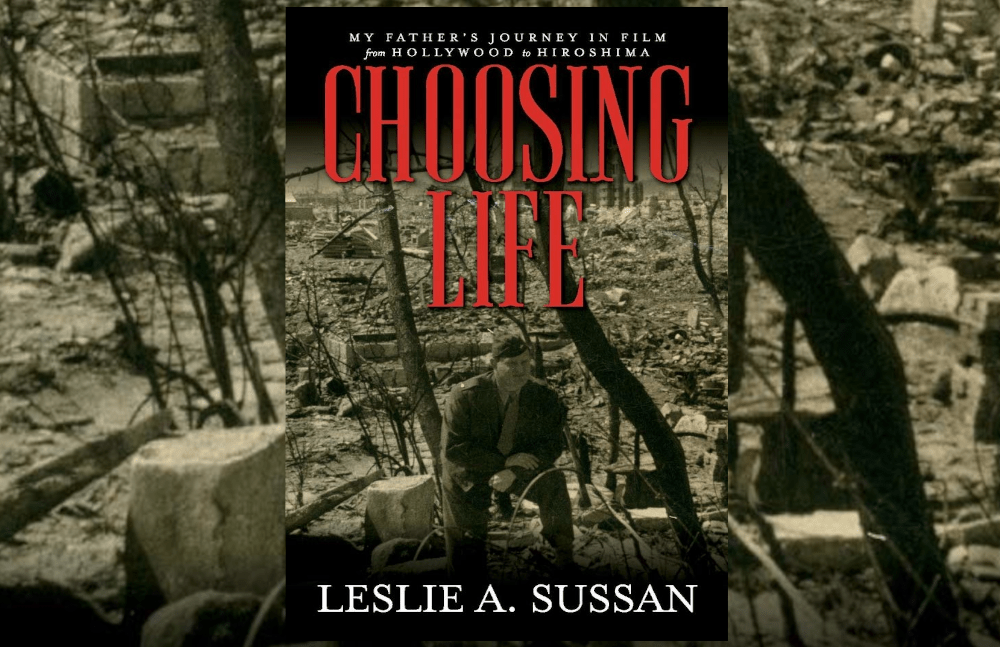
People have always been connected to their ancestors in one way or another. But most records, gravestones, or pictures will never be able to give us the real comprehension of our past family. Most people will not even really know their parents very well. This was true for Leslie Sussan, the author of Choosing Life: My Father’s Journey from Hollywood to Hiroshima, and only after her father died did she start to really discover who he was and the experiences he had. When searching the archives, the discovery of tape recordings her father made was going to change both Leslie’s life and understanding of her family and the far-off country he came to love.
Choosing Life charts the journey of Herb Sussan, whose passion for cinematography took him from the Hollywood hills to some of the most famously tragic places on Earth. Having been given the opportunity in the US military to do a service to the world, and record both the devastation to the cities and the physical damage to the people left behind in 1940s Japan, he was part of a team who were tasked to document the aftermath of what the survivors called pikadon – the atom bomb. Though he went to Japan with the standard outlook of a military man in the occupying forces, not expecting much different than the standard war damage, what he experienced set him apart from most of his fellows, and changed him forever. From seeing the devastation of the cities that left, at most, only shells of buildings, or at worst just a shadow of whatever had been ‘vaporised’ [deeper research argues against literal vaporisation], to the barely alive recipients of the atomic blast – having lost limbs, had skin burnt through to bone, suffered radiation sickness, or experienced the loss of their whole families in many cases – Herb knew he must bring evidence of this destruction to the world.
What he experienced set him apart… and changed him forever
But this biography doesn’t just follow Herb; it also charts the journey of his daughter – the author – in her quest, after his death from a possibly radiation-related cancer, to not only uncover the life and experiences she didn’t fully know he had, but her own discovery of the contemporary Hiroshima and the people who had survived, and were now sharing their stories with the world. Even before discovering her father’s oral recordings of his experiences, Hiroshima felt like home, and she took the leap to move there with her young daughter. Her intention was to scatter her father’s ashes, but this was in conflict with the Japanese tradition, so she instead arranged a memorial for him, starting her journey into the culture, traditions and daily lives of the people of Hiroshima. Although she was saying goodbye to her father, she was also saying hello to so many people who were continuing his quest to bring the horrors of Hiroshima and Nagasaki to the world.
It is in essence a multi-biographical memoir, thirty years in the making and covering three generations of a family at its core. But it isn’t limited to the author’s family. It encompasses the people who were left behind in Nagasaki and Hiroshima, many with life-changing injuries, who are called hibakushu. While challenged with the taboo of being ‘tainted’ by pikadon’s effects to keep silent about their experiences, they found the courage to speak out against nuclear war. Forming groups such as the Ten-Feet Campaign, some of the people became like a second family to Herb, Leslie and Kendra (the author’s daughter), and though some have sadly passed away, many are still in regular contact.
A multi-biographical memoir, thirty years in the making and covering three generations of a family
To be able to pass on the story of not only your father (and some of your family), but of yourself and your daughter, in a way that shares private and intimate details of your life and experiences is not an easy task. It is also difficult to ensure the balanced treatment of other people in the past, especially those whose actions or opinions may not have aligned with the biographical subject. The author manages to show us as much information as she can reasonably be expected to with the evidence, and also understanding in other people mentioned who are not her subject. And it parallels the same kind of message the hibakushu share: about understanding and forgiveness as the only way to move forward from the horrors some inflict on others. One of the biggest roadblocks to the world knowing the true extent of the atomic damage to Nagasaki and Hiroshima was the sudden ‘Top Secret’ classification of the reels of footage and written documentation that was suddenly called in by the top brass, and subsequently locked away. Herb was offered the chance to use some of the footage in military training videos. He declined and never got to see it released.
[The book] parallels the message… about understanding and forgiveness as the only way to move forward from the horrors
Choosing Life is a fascinating, personal, and sometimes horrifying book, that exposes pertinent reasons why the world was not given full disclosure about the nature of atomic bombs at the time of the atrocity. It is absolutely full of so many poignant, harrowing, determined and uplifting moments, they cannot be all covered in a short review. It is also a lesson in forgiveness. The Japanese hibakushu in Hiroshima, continue to share their stories about their experiences to teach the kataribe – which means bearing witness – to the younger generations, ensuring the horrors are not forgotten, but also to encourage understanding and unity between people internationally, to ensure it does not happen again.
A final point about the book is seeing and experiencing first-hand is what ultimately changes people’s views in life. The pictures of the devastated cities are haunting, and the captures of the ghost images – objects and people literally leaving “shadows” of their former physicality against walls and steps as they were hit by the blast – are utterly chilling. But the courage of the hibakashu, and the determination of a small family from the country which instigated the attacks, speaks volumes in the wish to embrace their fellow people and continue building the bridges that give hope to future generations, but also ensure they are aware of what can happen when we allow the power hungry to prevail.
Image: Leslie Sussan (BookBaby Publishing)


 HEX
HEX 
Leave a comment