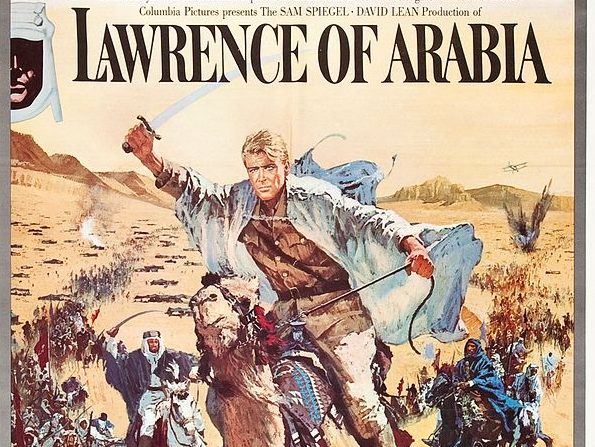
As with many biographies, and as the author points out, most people probably know what they do about Lawrence of Arabia from David Lean’s famous film. The dashing, daring, smart, witty sides of him and the dark, ruthless, disturbing and destructive others, expertly portrayed by Peter O’Toole in arguably one of the greatest films of all time. According to this book, and Lawrence’s own writings, that portrayal was not wholly off the mark. Though the film took creative liberties where necessary, it did not shy away from the more delicate subject matter – albeit artfully alluded to considering the time period it was made – to ensure the film was a complex character portrayal and not just a gung-ho desert epic for a war hero.
The film was a complex character portrayal and not a gung-ho desert epic
Legion: Thirteen Ways of Looking at Lawrence of Arabia sets up the journey through Lawrence’s character by examining thirteen different angles in detail, both objectively and from the subject’s own writings and private letters. The chapters cover research such as Hero, Villain, and Queer amongst others, and builds a picture of this complex individual that might leave one even more confused as to who this man really was. The narration is excellent, and I was never once bored.
Thomas Edward Lawrence – known in his younger days as Ned – was born out of wedlock to an Anglo-Irish father who rejected his privileged upbringing to live with his mistress, Lawrence’s mother. He was subjected to an intense relationship with his mother, who seems on all accounts to have been a very strong influence over her children and her husband. Of all her children she would beat only Lawrence, but it was also Lawrence to whom she showed the most affection. She was so disturbed by her own ‘living in sin’ and it was likely that Lawrence absorbed some of this self-deprecation at an early age, which caused some developmental issues when it came to intimate relationships.
It was likely that Lawrence absorbed some of [his mother’s] self-deprecation at an early age
But, whatever the effect, Lawrence seemed to show a developing genius, and a resolute recklessness, from an early age. From obsessively seeking out medieval brasses to journeying on foot across Syria, Lawrence seemed to find it difficult to not only stay still in body, but in mind. He became a mechanic, sculptor, writer, an expert gunman, and an archaeologist, all before he became the Lawrence of Arabia that lives on in public memory. He wasn’t a huge fan of the human race, or animals in general, and he liked being able to travel at high speeds, the only time his mind seemed to switch off. He was friends or acquaintances at least, with a great many people, including the poet Shaw and his wife, the latter of which seemed like a surrogate mother to him. He also had compulsions to be whipped by various men, having self-flagellated many times throughout his life.
Lawrence seemed to show a developing genius, and a resolute recklessness, from an early age
Through the different chapters we see multiple views from multiple sources of this genuine enigma of a man. A reckless wanderer who persistently challenged his body’s limits. A British imperialist, thinking only of his own country’s ascension. An extraordinary linguist, who could produce immediate and powerful live translations of speeches from Arabic to French. A military genius, capable of drawing in the trust and loyalty of Arab forces. A closet homosexual, whose revulsion of touching meant he could never pursue the feelings he lived with. A rude soldier, who bore no respect for authority. A legend in his own lifetime.
It seems Lawrence was possibly all of these things, some more than others. But it also seems he was a genuine polymath and Renaissance Man, and had no problem with quickly developing expertise in anything he put his mind to, acting upon his impulses to explore and discover. Through being selective in his creative output he was able to manipulate how others saw him, making it difficult for those wanting to know him better. After listening to this book, it seems Lawrence would probably be perfectly happy with that outcome.
“Lots of people go about saying they alone understand me. They do not see how little they see, each of them separately. My name is Legion.” – T.E. Lawrence
What is certainly true, however, is that despite his own impartiality for other people on the whole, and his own writings showing his lack of care for “animals” (humans included), he died from a motorcycle crash at 47 whilst swerving to avoid two boys cycling on the wrong side of the road (although the film Lawrence: After Arabia introduces the idea he was assassinated). Whatever happened, and whoever he truly was, Lawrence may very well remain an enigma for eternity, and he would probably be happy with that.
Image: Howard Terpning via Wikimedia Commons


 HEX
HEX 
Leave a comment