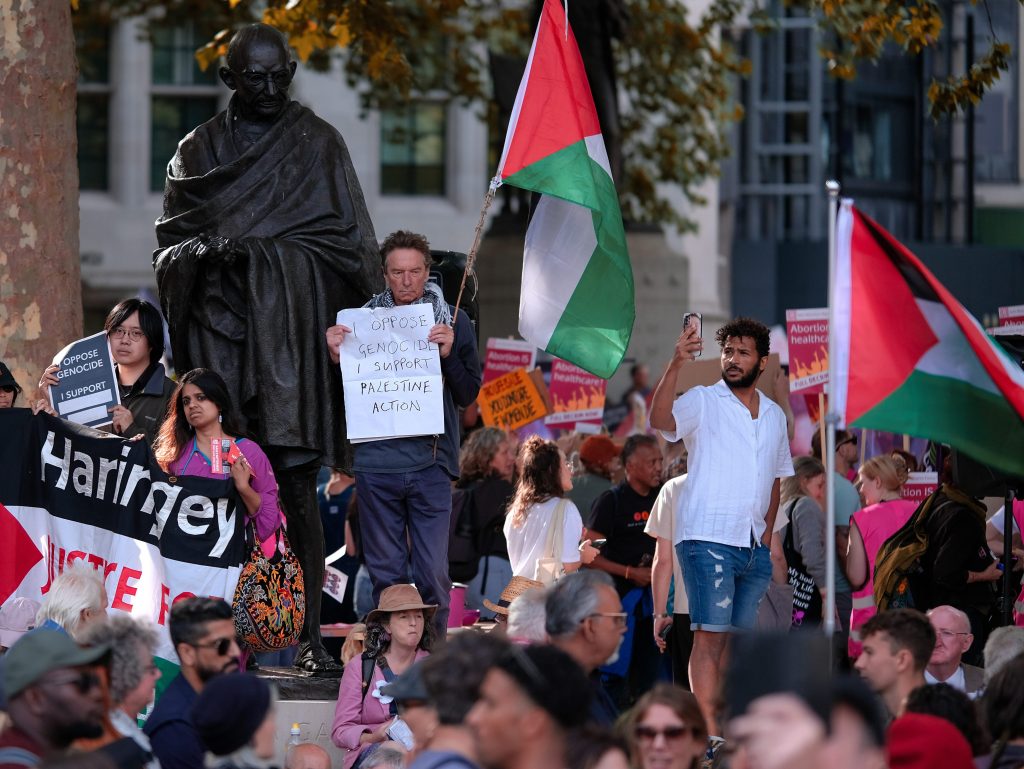
On 5th July 2025, Palestinian Action joined the likes of ISIS, Al-Qaeda, the Wagner Group and National Action as a proscribed terrorist organisation. The inciting incident? Activists breaking in to RAF base Brize Norton to spray paint military planes, which the group say were being used to refuel Israeli fighter jets in their war and genocide in Gaza. Home Office Minister Dan Jarvis explained the decision, arguing that “Palestine Action is not a legitimate protest group” and that “people engaged in lawful protests do not cause millions of pounds of damage to national security infrastructure.”
But is that true? While Palestine Action were clearly guilty of committing criminal damage as defined by section 1 (1) of the Criminal Damage Act 1971, it is a completely different question whether they qualify to be proscribed as a terrorist organisation. The Terrorism Act 2000 defines terrorism as the “use or threat of action” to “influence the government or an international governmental organisation or to intimidate the public or a section of the public, and the use or threat is made for the purpose of advancing a political, religious or ideological cause.”
This is a vague definition that could include a wide variety of groups, from Palestine Action to climate organisations like Just Stop Oil and Extinction Rebellion, as well as the English Defence League, following the riots in August 2024. Only Palestine Action is proscribed. In response, the last few months have seen over two thousand arrests as of mid-October on suspicion of supporting a proscribed organisation, an offence which carries a 14-year maximum sentence. This is clearly an unprecedented and overreaching use of Terrorism law, that is being used to silence debate on the streets on issues such as Britain’s involvement in the genocide in Gaza.
This is clearly an unprecedented and overreaching use of Terrorism law
The proscription of Palestine Action adds to an ongoing debate on laws surrounding the right to protest in the UK. In the last five years, there has been an ever-increasing series of restrictions on protesting. For example, it was in 2021 that the sentencing limit for supporting a terrorist organisation increased from 10 to 14 years. Then, in 2022 the Police, Crime, Sentencing and Courts Act added restrictions on protests in the wake of both Black Lives Matter and Extinction Rebellion demonstrations over the previous years. These include noise limits, start and end times, and restrictions on occupying public places and blocking roads. Further restrictions, now deemed illegal, were introduced in 2023 by then Home Secretary Suella Braverman through “Henry VIII” ministerial powers. Despite the rejection of the government, these measures allowed police to restrict protests that caused “more than minor” hindrance to people’s lives, and were used to detain Greta Thunberg in 2024.
The Labour government has continued to further restrict free speech and protest, with bans on face coverings and restrictions on repeat demonstrations currently making their way through parliament. Yvette Cooper condemned the previous restrictions as shadow Home Secretary, but in the 14 months since the Labour government took over, she has pursued further restrictions, including leading the proscription of Palestine Action.
These restrictions are antithetical to the right to protest and free speech. These are fundamental aspects of democracy and ensuring that the voices of everyone in the country are heard. This is especially true for minority groups in the country, who are commonly side-lined by the calculus of electoral politics. It has been through protest movements that major achievements have been made, like women’s suffrage in the interwar period, poll tax protests that forced both the policy and Margaret Thatcher out, and the Bristol Bus Boycotts. Internationally, protests have been instrumental in overcoming discrimination, like the US civil rights movement and holding the government to account, such as the 2014 Revolution of Dignity in Ukraine and the South Korean anti-martial law protests last winter.
These restrictions are antithetical to the right to protest and free speech
The UK government’s restrictions on the right to protest and free speech are a sign of a political establishment that is unwilling to listen to the people that it is supposed to serve. However, it is misguided to believe that these restrictions will stop opposition to the government. History, even over the last few months, has shown us plenty of times that this is not the case.
Image: Alisdare Hickson via Flickr
 HEX
HEX 
Leave a comment