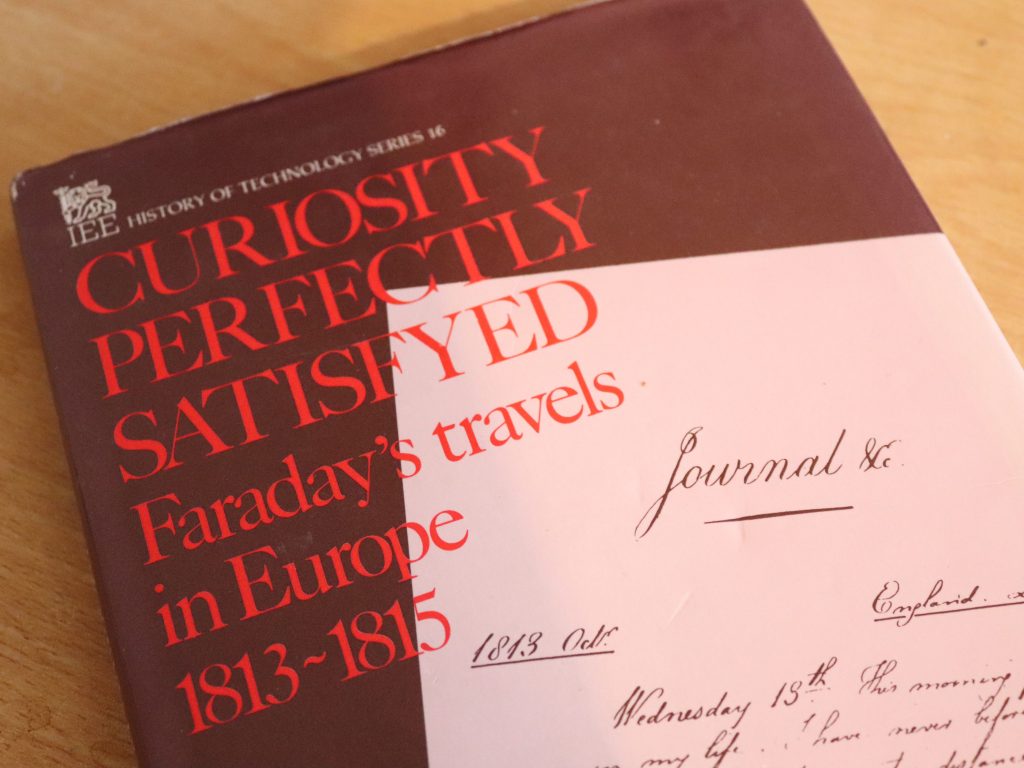
All the biographies in all the world will never be able to replace the words from the horse’s mouth. Blessed we are to be able to access the thousands upon thousands of letters that Michael Faraday either wrote to others, which are more substantive, or received from them. He was a self-proclaimed letter-writer, but also an exceptionally adept journalist.
Between 1813 and 1815, Faraday travelled with his Royal Institution mentor, Sir Humphry Davy, to Europe, on a tour both for research and networking. His adeptness in describing journeys and experiences in varying forms – objective, inquisitive, amusing, judgmental, passionate, questioning, observant – all allow us to see the complex personality of one of history’s greatest people, and that is not stated lightly.
Michael Faraday is known well for his exquisite experimentation. Indeed, this is the reason anyone can pick up the relatively simple tools he used and replicate his world-changing experiments even now, a hundred and fifty-eight years after his death. The journal Faraday wrote early on in his service to Davy whilst undertaking in part a grand tour and part a lesson in Georgian class distinction, is an exquisite look into the workings of a fairly young mind (he was about twenty-two when they commenced the trip), whose education was in majority self-taught, and whose pride was built on both that self-education and the strong structure of his family and friends.
Part a grand tour and part a lesson in Georgian class distinction
Another part of this assertive nature was probably due to Sir Humphry himself. As a man who had grown up in not dissimilar circumstances to Faraday, he was not a flailing gentleman, but a rockstar scientist, who also knew well his strengths. This was evident as soon as the journey commenced. The valet Sir Humphry had expected to accompany them (himself, Faraday, Lady Davy and her maid) turned down the trip due to his own wife’s worry (as Faraday notes later in the journals to his friend Benjamin Abbot). Davy asked Faraday if he would mind acting as valet just until they found one along the way, and reluctantly he agreed. He had originally accepted the journey providing he was an assistant to Davy, and not his servant, but needs must. Davy never overstepped his expectations, we read, and did much of the expected valet requirements, as he was used to looking after himself. However, anything he did require Faraday to do were done as requested by the younger man. Valet to a knight was not a position to be scoffed at per se; it required full trust from the recipient, and Faraday had that from his mentor.
The problem was Davy’s wife. She showed contempt for Faraday for a good portion of the journey, and an incident is noted where there was a dinner one evening with many ladies and gentlemen, and Lady Davy stated Faraday would eat his dinner in the kitchen (with the other servants). Later, when the dinner was over and the men and women were to retire to separate rooms, Davy announced to his friends that they would go and join Mr Faraday in the kitchen. It was not a particularly usual thing that knighted men would defy such social expectations, but Faraday noted that Davy was often torn between supporting his wife or supporting his trusted assistant, and it’s no surprise that even after the conflict the two experienced later in Faraday’s career, the student still saw Davy as a great man.
The journals show Faraday as a severely conflicted young man in parts. Woven neatly into the diary narrative, the editors have included extant letters Faraday wrote to his friends and family along the way, and they give us an excellent overview of not only his journeys, but also the extravagance and hardships (like the above Lady Davy conflict) he experienced along the way. He came from industrial London to the vast expanse of Europe, and the great cities that occupied it. He travelled though small villages, saw exquisite architecture, attended balls, visited Roman palaces, traversed Vesuvius, and investigated (with great hilarity and exclamation marks) the nature of glow-worms.
The journals show Faraday as a severely conflicted young man in parts
As time went on, it was clear from his letters that he was missing his friends and family severely, and though he was passionate about discovery and exploration, being away from those people certainly affected his mental state. It is also likely that he was trying hard to hold himself together in the face of the hostility he received from Lady Davy, and even though he took the disrespect gracefully, and managed gradually to claw back his dignity during each put down, eventually gaining enough ground that he generally ceased being a target for her, it still clearly affected his passionate and proud nature. It isn’t surprising at all; Faraday had an upbringing that shouldn’t have risen him above the trade his father held, but through his own determination, and the strong support of those who saw his potential, he became assistant to the great Sir Humphry Davy and the recently established Royal Institution. This grounding stayed with him, and the roots of it can be seen very clearly in these diaries.
As one of his friends stated, no photograph or painting could ever really show the true face of Michael Faraday, as it was so changeable and animated. The same can certainly be said for his letters and journals, giving us an ever-evolving appreciation of this great man from his own words, worries and wonder.
Curiosity Perfectly Satisfyed is edited by Brian Bowers and Lenore Symons.
Image: Jessica O’Toole (cover by Peter Peregrinus Limited)

 HEX
HEX 
Leave a comment