Before even setting foot in the concert hall for an evening of live orchestral music, I was greeted by Darth Vader and an entourage of other Star Wars characters, posing for photographs outside our own Gala Theatre. This was the work of the North East Legion, who were supporting this wonderful concert at the same time as raising money for the North East Air Ambulance.

The concert opened in rather cliché fashion, with the instantly recognisable drone that opens Stanley Kubrik’s ‘2001: A Space Odyssey’, taking from Richard Strauss’ ‘Also sprach Zarathustra’. This made me think back to a concert I performed in the very same Gala Theatre a little over 2 years ago, where Durham University Orchestral Society paired Holst’s ‘The Planets’ with ‘Also sprach Zarathustra’. It’s fair to say that it did feel initially a little stereotypical opening a space themed concert in this manner, but that didn’t stop the orchestra from sounding wonderful right from the start.
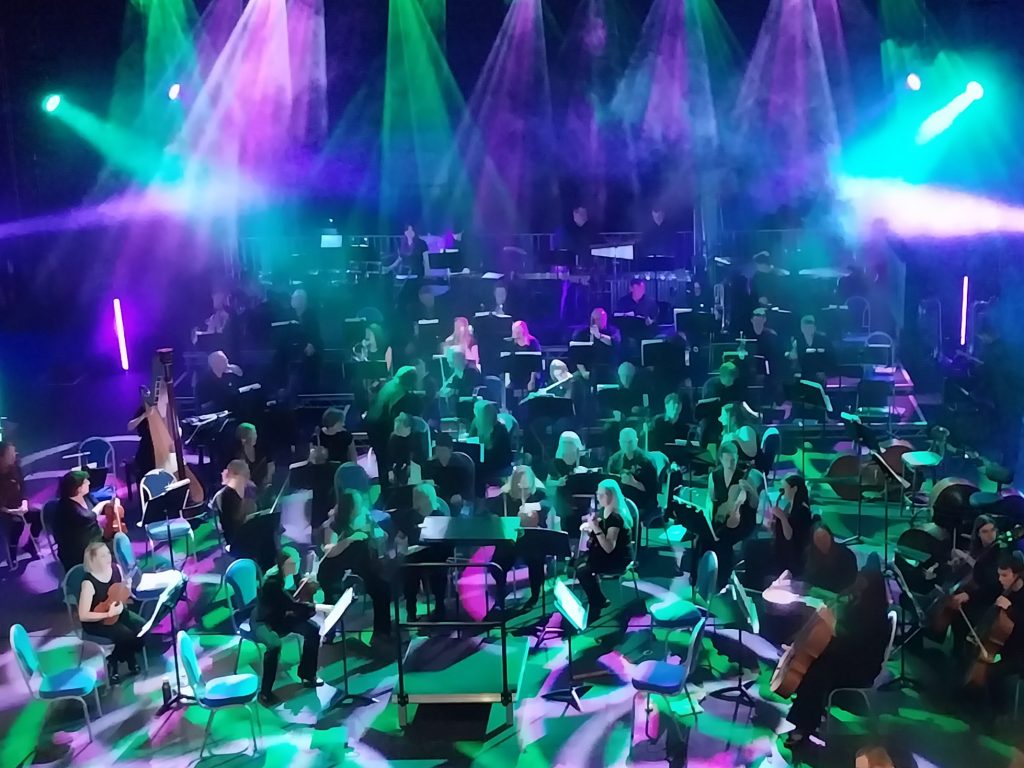
We were then treated to a wonderful light display during the ‘Flying Theme’ from John William’s score for E.T. This wonderful lighting was the work of Darren Lowe, without whom the concert would have felt completely different. This lighting display was immediately bested by the one that hurtled us through space to the sound of ‘Star Trek Through the Years’. The lighting changed perfectly to encapsulate the different Star Trek themes from its wonderfully diverse history that were heard in this phenomenal medley from the original through Deep Space 9 and Voyager.
The radical idea of pairing an orchestral concert with theatre-style light shows definitely elevates the entire experience to a much higher level, meaning it sticks out in my memories instead of blending into the dozens of other concerts I will see this year. After their success at Halloween last year with this idea, it was great to see the North East Film Orchestra continuing this for a second shot, now with new music. I would love for this style of lighting to become standard in concerts, especially the ones targeted to include a younger audience, such as the film music concerts I watched The Hallé put on annually throughout the later years of my school life. It would definitely have convinced some of my peers who are not quite as music obsessed as me to tag along, expanding the audience of classical music enjoyers.
We were treated to Hans Zimmer’s phenomenal score from Interstellar, which really showcased the pure power of the orchestra
Our next treat was arguably the most famous piece of classical music written about space: ‘Mars’ from Holst’s ‘The Planets’. As with the Strauss that opened the concert, there were a few places where I was left wanting even more sound from the orchestra, but that’s what happens when you only have 65 musicians compared to the typical orchestration of over 80 musicians for Holst.
Apollo 13 was the only score in the first act that I wasn’t already familiar with, but perfectly captured the vast expanse of space, with principal trumpet player Billy Bradshaw performing an exquisite solo from the circle, looking down on the orchestra who were providing him with a beautiful sonic backdrop. This was in excellent contrast to Close Encounters of the Third Kind, where heavy use of extended performing techniques showed us a much more sinister imagination of the unknown.
To close the first half, we were treated to Hans Zimmer’s phenomenal score from Interstellar, which really showcased the pure power of the orchestra, similar to ‘Mars’ and ‘Also sprach Zarathustra’. This is a perfect place to mention the keyboard, which in Interstellar was used to great effect to provide the immense power of an organ, and felt so at home. There were, unfortunately, a couple of places in other pieces where the sounds produced were a tad loud, meaning the delicate nature of the performance was slightly lost.

The second half opened with the incredibly crisp ‘The Avengers Theme’ by Alan Silvestri. This was masterfully put together by the orchestra, once again with incredible lighting design. Unfortunately, this was the one point in the show where the lighting was ever so slightly jarring, as its rigid movement didn’t quite match the tempo of the orchestra. There were so few elements of fault in the concert that the most minor of issues were amplified, so this could be seen, in a twisted way, as a complement on the overall production value I’ve already raved about.
‘Man of Steel’, Zimmer’s second feature in the concert, was a piece that was new to me, and I have to say I really enjoyed all of it, especially the characteristic forward momentum that Zimmer brings to all his work. It was followed by Strauss Jnr’s ‘The Blue Danube’ waltz. When I saw this was going to be played, I was initially a little disheartened, as this would have been a great spot in the programme to feature a lesser known piece such as Langgaard’s ‘Music of the Spheres’ or even better, a work by William Herschel, who led a double life as both the astronomer who discovered Uranus, but also a writer of 34 symphonies. However, conductor Lewis Wilkinson spoke about the use of ‘The Blue Danube’ waltz, and convinced me otherwise on the matter, and the orchestra certainly did it justice.
Possibly one of the best concerts I have watched in a long time
You may have noticed a certain omission so far: Star Wars. That is because there were several pieces from John Williams’ scores for Star Wars at the end, featuring the main titles, ‘Princess Leia’s Theme’, ‘Imperial March’, ‘Yoda’s Theme’, and ‘Throne Room & Finale’. All of these were fantastically performed, with laser displays showing us lightsabre fights, TIE (Twin Ion Engine) fighter chases, and the X Wing, as well as a feature from the North East Legion on stage, allowing Darth Vader himself to walk on stage to the sound of The Imperial March! Following the well-deserved standing ovation, we were treated to an encore: an orchestral imagining of ‘The Final Countdown’, drawing a magnificent end to a wonderful evening.
Were there things I would have done differently about the concert? Yes: I would have programmed Doctor Who, to make myself feel better about having to delay watching the series finale by a whole 3 hours! Does that change this from being what is possibly one of the best concerts I have watched in a long time? Absolutely not. A massive congratulations should not just go to the brains behind the production, Lewis Wilkinson, nor the genius who designed the lighting to ensure such an incredible production, Darren Lowe, but also every single member of the hugely talented 65 strong orchestra and all the other incredible behind the scenes magicians who ensure that the next generation are coming to watch orchestral music in this 5 star work of art.
Image: Dan Wattis

 HEX
HEX 
Leave a comment