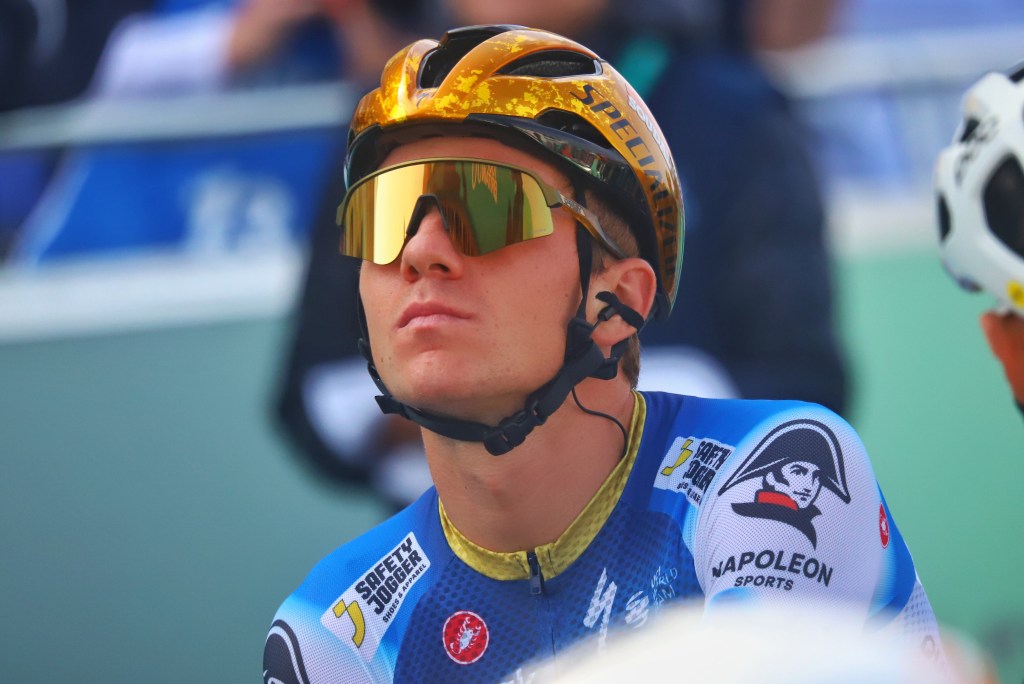
When a race lasts upwards of four hours at a time, and the Tour de France has that every day for 3 weeks straight, the sport of road cycling can be very daunting to a new watcher. Couple that with the different sub-competitions that happen in every race, as well as the fact that it can be very hard to actually find a way to watch the races you want to, it is no wonder that it struggles for viewership in the modern age.
One of the most famous British athletes in the sport is the recently retired Sir Mark Cavendish, but his best result in the Tour de France was 130th out of 155 riders in 2009 (modern results have him listed as 127th out of 152 riders due to 3 participants being disqualified after the race due to doping), so what made him so successful? For Cavendish, it is not the ultimate finishing position of the three-week race, but winning of individual stages within. This split of different objectives and roles within larger races is one of the things that is confusing to many new watchers of the sport.
“[Riders crave] being able to produce over a thousand Watts of power for a matter of a few seconds after a relatively easy race.”
Within the 2009 Tour de France mentioned above, 7 of the 21 stages finished in group sprints of riders at the end of a very flat stage. Cavendish won 6 of these, and in so doing cemented his spot as the best sprinter in the world at that time. Different riders excel at different parts of the sport, in a way that is completely different from any other racing sport I can think of. Riders like Cavendish, or his more recent counterparts of Tim Merlier or Jonathan Milan, crave the sprint victories – being able to produce over a thousand Watts of power for a matter of a few seconds after a relatively easy race with low energy expenditure, reaching speeds of 40-50mph in those few seconds just before the finish line.
The way the Tour de France works is that there are 21 stages of all different kinds, with the ultimate winner and wearer of the coveted Yellow Jersey being the rider with the quickest combined time at the end of it. While Cavendish won 6 stages, one of only two riders to win more than just 1 stage at that year’s race, he lost massive amounts of time on the stages in the mountains, because that is not his specialty. The final winner of that year’s race was the Spaniard Alberto Contador. He was able to finish in the same group as Mark Cavendish on the flat stages, hence getting the same finishing time, but in the mountain stages, he was able to finish on his own, ahead of the rest of the riders, gaining time on them. It is this ability to be the best on the uphill finishes consistently throughout the three-week race that normally determines the final victor. Winning a single mountain stage is not enough on its own though, the ability to finish consistently in the front group or close to the front is arguably more desirable; Chris Froome managed to win the overall classification in 2017 without ever winning a stage, something replicated by his teammate Egan Bernal two years later. Both managed to win the overall classification by being consistent in finishing near the front, where other riders won some stages but lost significant time on other stages.
Winning is not the whole story though, on some of these hard, mountainous stages, Contador did not win, instead letting riders who were not in contention for the overall victory take the individual stage victory, while Contador focused on merely gaining time on his competitors for the overall victory in Andy Schleck, Lance Armstrong and Bradley Wiggins, who ultimately finished 2nd, 3rd and 4th (prior to Armstrong’s subsequent disqualification due to doping). This strategy of letting riders who are not competing for the overall victory take the individual stage victories is a common strategy, as it allows the riders to conserve some amount of energy in focusing on defeating their opponents for the overall victory. The riders who do win are often called breakaway riders, as the moves that are allowed up the road are the breakaway, which are sometimes never caught, only sometimes deliberately not caught too.
With this lengthy overview of the sport now covered, it is time to make the argument for why Road Cycling is such an exciting sport. The variety of stage designs mean that there is a diverse pool of winners. In the 2009 Tour de France which has been referenced extensively throughout this piece, there were 15 different victors over the 21 days of racing. The diverse pool of winners means that inevitably there are massive outsiders win stages as well. At last years’ Tour de France, the stage winner on Stage 2, Kevin Vauquelin, won after being in an early breakaway that formed with around 190km of the race left to go. Before the stage, the bookmakers had Vauquelin at odds of over 1 in 250, and yet he still won. Unpredictability and underdog stories always make for entertaining affairs, but there is still enough predictability in racing that it is not a shot in the dark. The pre-race favourite for the overall classification, two-time previous champion Tadej Pogacar, still won the Yellow Jersey at the race’s conclusion.
A key part of why I love cycling is the strategic element. In the 2022, the favourite going into the whole race was the aforementioned Tadej Pogacar of Team UAE Emirates, followed by Team Jumbo Visma’s Primoz Roglic. Unfortunately, on the 5th stage Roglic suffered a heavy crash, losing him around 2 minutes to other competitors for the overall victory, including Pogacar, but also his very strong team mate, and 3rd favourite going into the race, Jonas Vingegaard. Over the next few stages, it ended up that Pogacar was leading the race followed by Vingegaard, and then a pair of teammates, the Brits Geraint Thomas and Adam Yates, with Roglic down in the 10-15th place region on around 3 minutes of Pogacar.
“A key part of why I love cycling is the strategic element.”
Things were all to change on the 12th stage, featuring the mythical Alps of Col du Galibier and finishing on Col du Granon, both infamous climbs in the history of the Tour de France. Over the first two of the three climbs of the day, Roglic and Vingegaard alternately attached the pre-stage favourite Pogacar, forcing him to close each and every attack they made, wearing him down While the rest of Team Jumbo Visma sat in the wheels, following the draft. Having to continually close gaps wore through Pogacar’s energy, while everyone else could sit in his draft, using substantially less energy, even on the steepest gradients. By the final climb, Pogacar was too tired to shut the gap between himself and Vingegaard when the latter did attack for the final time, and lost nearly 3 minutes to Vingegaard, as well as any competition for the ultimate Yellow Jersey. Vingegaard arrived in Paris the week later as the first Dane to win the race since Bjarne Riis in 1996, who has since admitted to using performance enhanced drugs to aid this victory.
The Tour de France is not the only race in cycling, there are 36 races at the highest standard of Men’s cycling, ranging from 1 day race, through to week long races, or the three-week affairs in France, Spain and Italy. Women’s Cycling is also flourishing; a lot of races these days have a men’s and women’s race that run consecutively, with the women’s often being more entertaining and unpredictable races, such as the Tour de France Femme avec Zwift last year, which featured some incredibly entertaining racing. There is a whole world of racing to explore beyond the infamous Tour de France which is all so exciting, even if some races last upwards of 6 hours!
Following Cycling is not without its challenges: the sport has still never recovered from the doping scandals of the 1990s and early 2000s. The Tour de France has a period of 7 years with no official winner, due to Lance Armstrong’s stripped titles never being allocated to another riders, as all of the contenders have either admitted to using performance enhancing drugs, or have had team mates come forward and say that they did. The legacy of performance enhancing drugs, in particular EPO, has never left the sport, with cycling coming under much more intense scrutiny than many other sports even to this day. Even within the last couple of years, top riders have been found to be using banned substances, and subsequently disqualified from races as big as the Tour de France, such as Nairo Quintana, who lost his 6th place overall and all his stage results from the 2022 race after testing positive for tramadol, which has been banned in cycling since 2019, and by WADA since 2024. These anti-doping rules violations continue to dampen the sport in the public consciousness, despite other sports such as tennis having more egregious violations in recent times, due in part to the tarnished legacy that cycling has.
Arguably a bigger barricade to following the sport, however, is actually being able to watch the racing in the first place. Due to its somewhat obscure nature as a sport, mainstream TV increasingly rarely broadcasts races. In 2025, only a select handful of races are broadcast free to air in the UK, including the Tour de France and the Tour of Britain, although this is the last year that the Tour de France is set to be aired in the UK for all to enjoy, as ITV have lost the rights to broadcast for 2026. The streaming scene for Cycling has also crumbled in recent years. In 2013, a new cycling streaming channel was launched on YouTube called Global Cycling Network, or GCN for short. Over the next 10 years, it grew and grew, eventually gaining rights for the vast majority of the cycling calendar at the highest level for a low subscription price of around £40 for the year. However it was eventually acquired Warner Brother Discovery, which means it has been ultimately absorbed into TNT Sports, gouging the price up to £33 per month, which is such a barrier to entry. Combined with the lack of free options, the sport’s viewership is inevitably on a downward trajectory as a result.
These two draw backs to make it harder for the ardent fans of cycling to follow the entire calendar, although the rise of YouTube and podcast channels, somewhat lessens the blow. More than ever, there are legal highlight videos being posted on YouTube by channels that make it far more digestible in shorter 5–8-minute videos for each race (namely Lanterne Rogue), or longer detailed podcasts that break down the racing for the more die-hard followers of the sport (Watt’s Occurring, LRCP or The Cycling Podcast), or even short form Instagram reels (How the Race was Won) for those with the limited attention span that would struggle with the 5 hours of racing that cycling normally entails.
Image: Dan Wattis

 HEX
HEX 
Leave a comment