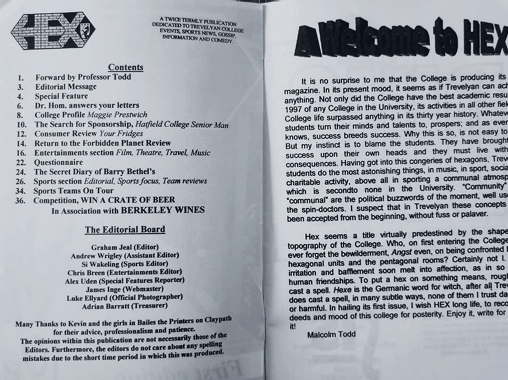
HEX’s long and tumultuous history as a satirical magazine started in 1998 with two second years, Graham Jeal and Andrew Wrigley, who were tired of missing college gossip from their Claypath dig (which Graham claims cost £45 a week).
“We were living out and feeling a bit excluded here, myself and Andrew Wrigley, so we came up with this idea of a newspaper, a satirical magazine, a little bit Private Eye,” Graham told me. The magazine was to be based off of the college bogsheet, sheets of A3 paper stuck up in college toilets that were full of gossip.
Bogsheets are a strange tradition within the UK’s oldest universities, though most have stopped as university culture changes. With the rising popularity of the internet, most became newsletters organised by the JCR rather than anonymous posters. In fact, the bogsheet was one of the Publicity Officer’s duties as late as 2016 at Trevs – but it had to be checked by Welfare Officers before publication.
“People living out never got to see any of those, and felt excluded,” Graham explained, “And, obviously, you can only get a certain amount of information on those A3 sheets.”
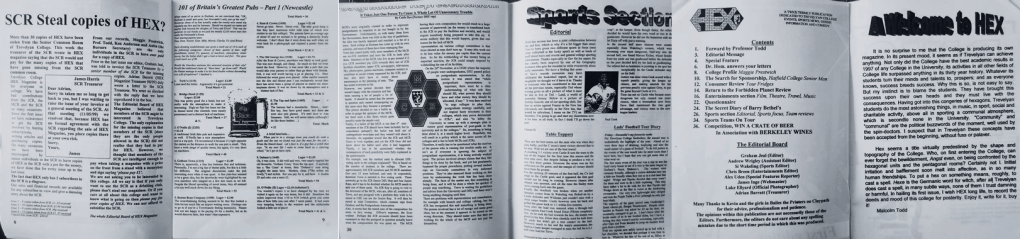
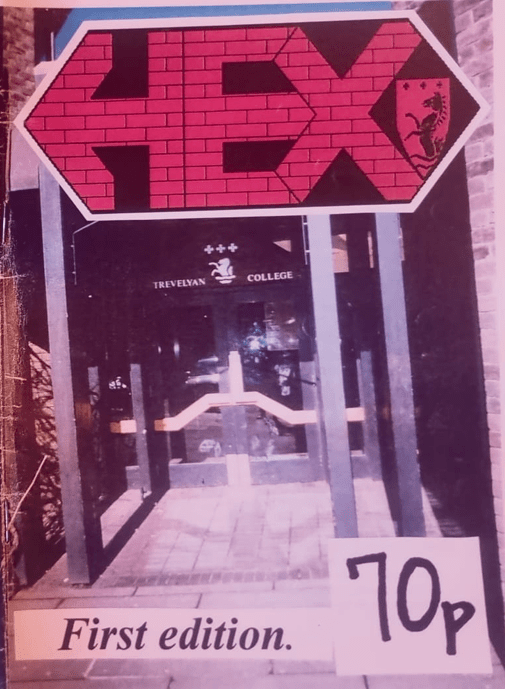
The natural next step for Graham was to build an Editorial Board and start printing. They produced 200 copies of their first edition in March 1998 in what would be a twice-termly publication. “We did sell them all, but I remember them being a little bit of a struggle,” Graham admits. They got their name out further in the second edition, as the front cover was a behind-the-scenes of the Summer Ball survivors’ photo, sneakily taken from a Trevs rooftop.
It wasn’t until Issue 3 in Freshers’ Week 1998 that the magazine really hit its stride. Living back in college as third years, Graham and Andrew were able to sell and deliver more subscriptions. “We harvested up all the Freshers for a subscription, and the third years returning, and we were able to push those living out to subscribe, too. It was several hundred,” Graham said.
In 1998-99, they produced 5 editions of HEX and subscriptions skyrocketed to 500. The Editorial Board were then able to secure sponsorships from local companies in town and stopped relying on a college grant from the then-Principal, the late Malcom Todd, who Graham thinks “quietly enjoyed the tone of the satire.”
Creating a magazine was very different in these early-internet days. “You’ll be horrified by this, but it was a combination of word, printouts, and a lot of Pritt Sticks,” Graham laughs. “When you’re fighting with a Pritt Stick, bits are stuck everywhere, you’re fighting with the page, thinking, have you even used the right font? So that’s why it’s all very limited!”
The team would put together a hard copy of the magazine by sticking all the sections together, which would then be photocopied by a printers in Claypath. Because of this, Graham remembers how “people used to throw photographs at me to try and get into HEX.”
Graham still remembers seeing the first edition, “it was an enormous source of pride for me, when in the first or second issue, I remember going into the bar, and the bar was packed, everyone with their heads in a HEX magazine. I remember looking around to my friend Andrew Wrigley and saying, ‘gosh, what have we done?’”
When I ask him if there’s anything he wants current Trevs students to know, he talks about how HEX landed him his grad job and brought great success in interviews. “Durham is a great university and Trevelyan is a great college at a great university, but the problem for undergraduates is, you’re in the same position as hundreds of other people. […] HEX allowed me to sit in an interview and talk about pulling a team together, and every interview I went to they loved to talk about it.”
One thing that’s resoundingly clear is that, though Durham may have changed, Trevs is still the vibrant community that it once was. Twenty years later, Graham looks back at his time at Trevs knowing that reuniting with his university friends, “they might have a few more wrinkles, but it was just like yesterday that you were together in Durham.”
Images via Graham Jeal




 HEX
HEX 
Leave a comment