Content warning: this article contains references to death, suicide and stalking
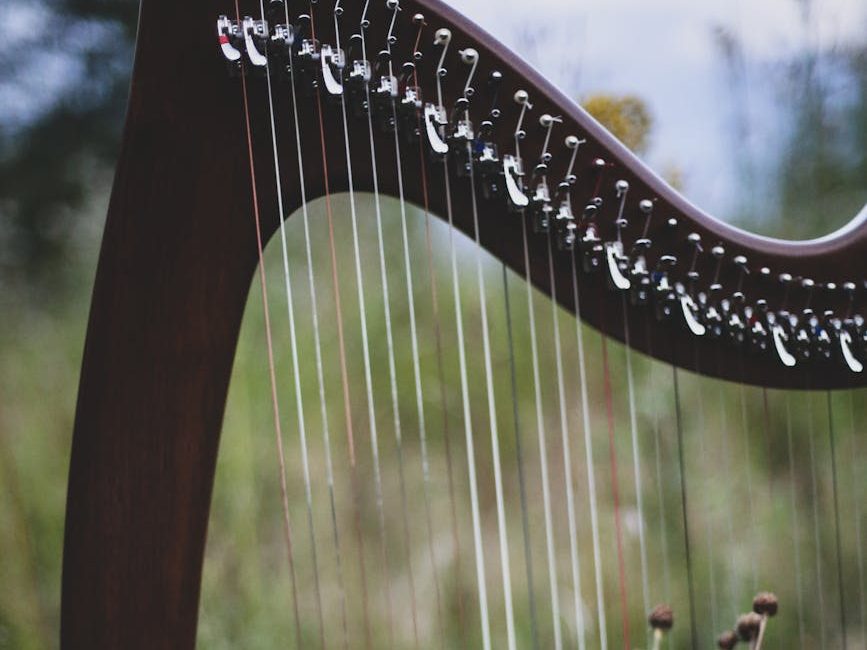
The musician’s cracked knuckles were pale against the smooth wood of his harp. As he spoke, he leaned away from the instrument, looking determinedly in front of him, yet his swollen hands stayed clenched around it.
“Of course she was pretty.” He sank further into his seat, the harp catching the movement and throwing it out as a faint hum. “That didn’t mean much in those days. The most beautiful women I saw couldn’t get enough of my music. But not her.”
The harp’s soft humming began to buzz. I felt it in my jaw, a subtle ache under my teeth. The musician leaned closer.
“I sang her songs of love and loss, mourning dirges, hymns to joy. Nothing moved her. My music had always been a bonfire that drew audiences like moths, but she wouldn’t leave the shadows.
“For the first time in my life, my music wasn’t enough.” He cast a bitter glance at the air around the harp, fingers clutched as tightly as ever. “The others meant as little to me as moths from then. I hated this woman’s indifference and loved her for it.
“Before then, I had been a magpie, drawn to those with the brightest hair, the most elaborate jewellery. Not her. Her hair was neatly braided, her dress an austere black and she wore only a single ring. Even so, she had me caught as surely as a fish on a line. I was at her mercy.”
The man’s voice was soft, spoiled only by the harp’s increasingly loud humming.
“I studied her as I had once studied my instrument,” he continued, raising his voice. “She was rarely alone. Faces changed regularly but never fully left, leaving her to be a placid stone surrounded by eddies of movement. No one seemed to be able to intrude on her self-containment. Conversations were courteous but brief, before the other person would fade back into the current of strangers.
“Though she was kind and lively enough to those who spoke to her, I saw that she tended towards a quiet melancholy when uninterrupted. A fast-moving song in a minor key. It was then that I returned to my music.”
His fingers bit into the harp, and I imagined I could hear a faint creaking, either from the instrument or from the musician’s bones grinding together. Still, he would not look straight at it, staring through me and into his past. The strings of the harp vibrated faster, swelling into an almost-melody.
“For seven days and seven nights, I worked on my song. Each note was wrought into place with a fury I had never felt before. I became a blacksmith, forcing a heap of slag iron to ring true.
“When my song was ready, I found her again. She was surrounded, as always, by meaningless people. It didn’t matter. My music cut through their noise and found her. As I played, her back stiffened and she turned to find the song that played her sadness for all to hear. Real tears gathering in her eyes. Finally, through a blur of sorrow, she saw me.”
The musician’s voice thickened on the last three words, and his eyes closed. Neither of us spoke. The hum of the harp swelled and crashed in time with his soft breaths. At last, he opened his eyes.
“Next day, I heard the news. She was dead. Suicide, obviously. Off to join her husband.”
The harp went silent. It gleamed sullenly as the old musician continued.
“Well, I couldn’t stand that. Not when I had fought to find her with my music. I wouldn’t allow it.” His face convulsed. “But I had her now, whether she liked it or not. I played her song, and it called to her, driving through rock and drawing me into the underworld.”
Now was the time to leave. I had indulged this madman’s rambling as long as he could expect. But his eyes burned with bitterness and the fading buzz had spread through my body into the earth, rooting me in place as securely as a tree. As tightly as the harp and its owner clung together. The musician continued.
“I tore through this world until I reached the next. My song drew us together in spite of everything. And I found her,” he said with savage triumph. “Nothing could hide her from me.
“She begged me to stay. She screamed and pleaded for her husband, but my song had found her and wouldn’t let her go. Step by step, the music dragged her back to the land of the living.
“Until my song failed.” Abruptly, the musician wrenched his head down and stared furiously at the harp in his hands. It lay meekly, a passive instrument in his control. I could see the musician’s hands twitch as if to scratch at the varnished wood, but he couldn’t loosen his grip.
“My fingers slipped on strings gone stiff and dull as wires. Not my fault.” His hands trembled, causing another slight, tuneless hum. “It wasn’t my fault.
“I can play through storms and sorrow. I played in the face of her desperate resistance. I could have carried on forever until she was mine. I didn’t – it shouldn’t have happened.”
He wasn’t looking at the instrument, or even at me, eyes closed in pain.
“She was gone. I was alone.”
Despite myself, I interrupted. “Why not play the song again?”
He answered reflexively, and I was unsure if he was even responding to my question or just blindly following the thread of his story.
“It’s too late. I can’t find her melody again, and this cursed thing deafens me each time I try.” He shook the vibrating harp without any real force to it. “She’s gone.”
The musician slumped; his burning story finished. The harp didn’t seem to agree. Its strings screeched discordantly, at odds with the satiated owner. Slowly, he came back to himself and focused on me as if surprised to see someone standing there. He grinned, eyes catching on the band on my left ring finger.
With unbearable, deliberate ease, the musician took one hand from his thrashing harp, fingers cracking and popping obscenely as he straightened them. He leaned forwards, ready to share another secret.
“Care for a bit of music?”
Image credit: Анна Малышева via Pexels


 HEX
HEX 
Leave a comment