If there is a weird thread that runs through my time at Durham, it is my intangible connection to coal.
As a descendent of Durham colliers, I have always been acutely aware of the ghostly presence of coal mining in my life and in the shaping of County Durham. Honestly, it’s a little inexplicable to me how an almost defunct form of heavy industrial activity – that was at its most bleak, deadly, dirty, and exploitative – became so deeply fascinating. As I was taught in some first year lecture, coal is the carbon rich sedimentary rock that forms in ancient wetlands. It is also a fossil fuel. It goes without saying that this is not a love letter to fossil fuels and the release of carbon, but to the people and place that were influenced by the coal.
From an external perspective, my subject of choice to study could explain this, with coal mining predictably being a feature in the first year of an environmental geoscience degree. But it runs so much deeper than this. Many things came together to make this. One of these was becoming deeply involved with brass banding in my first year. This uniquely British musical genre is inextricably associated with coal mining due to the colliery sponsored bands that sprung up in the 19th and 20th centuries, with many bands still holding the names of mines shut for half a century. In fact, the final remaining working colliery building in County Durham is the Easington Colliery band room. By the end of my first year it felt strangely inescapable.
This then developed into voracious research, consuming any book I could get my hands on about the Durham coalfield, and since then I have read hundreds of heartfelt accounts of the way such an industry shapes entire lives and generations proceeding it. I also had the unique experience of reading a text and strangely recognising the tale being told – with the life of my great grandfather referenced in the book unbeknownst to me, an odd experience I can assure you.
As a descendent of Durham colliers, I have always been acutely aware of the ghostly presence of coal mining in my life and in the shaping of County Durham. Honestly, it’s a little inexplicable to me how an almost defunct form of heavy industrial activity – that was at its most bleak, deadly, dirty, and exploitative – became so deeply fascinating.
In the majestic and peaceful city of Durham today it could be easy to think that mining was something that was happening externally in the many pit villages that pepper the county. But the carboniferous strata invariably continue under this city and the enterprising and greedy of the past didn’t leave this unturned – with mine shafts deep below the Bill Bryson Library and much of the science site. Further, if you catch yourself walking alongside the river below the ancient cathedral and Prebends bridge, look closely at the river cliffs towering above the languid Wear and find something far older. These banks preserve the coal swamps of the Carboniferous, with the cylic coal layers visible in the wall recording the rise and fall of river deltas and vegetation of this place 318 million years ago.
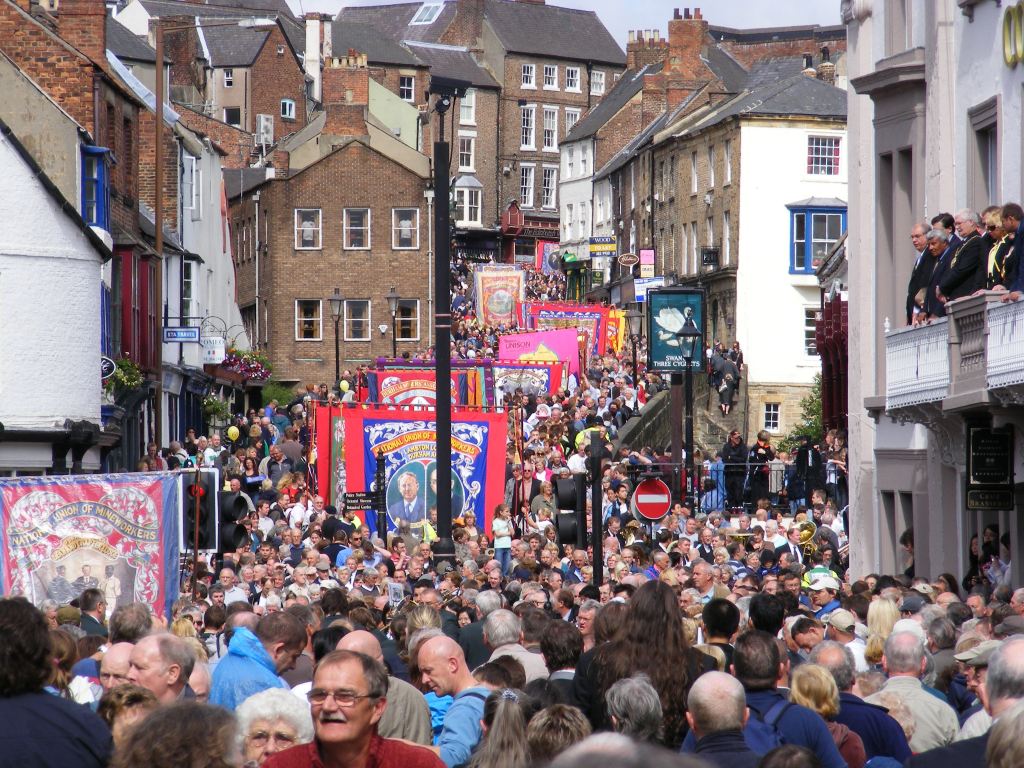
Since I arrived in Durham, attending the Miners’ Gala – a labour festival most typically associated with the coal mining trade unions – was something I had great interest in doing. Being a brass band member I was excited to play in one of the many bands that march beneath the vibrant lodge banners and experience something that is so unique and important to this city and county. I played at the 2024 gala, and this was a great experience. It remains a defiant and exuberant example of the legacy of this industry on the county. The proudness and resilience of people badly treated is also honourable and the way it still ties communities and people together long after it has ceased is unique.
When the time came to select a topic for my dissertation, I jumped at the chance to do a project centred on coal mining pollution and its legacy. This has made a process that can often be tedious far easier to be invested in and I feel strangely protective of the desolate bit of land nestled between the mining villages of South Hetton and Murton. As I go into the final few weeks of trying to write up my research it is hard to imagine finding more joy studying something else and it is weird to consider what I may have been writing about had I not developed this odd interest. The mine shaft I am studying still holds the European record for the most coal extracted in one day which is a staggering fact when you consider the amount of coal mining that has happened in Europe. It means a lot to contribute some understanding to this now empty place that changed the world.

Image: Caitlin Banbury
Economic and political transformation of the North East of England was fuelled by this strange black rock and understanding this on a geological, sociological and economic scale has been key to understanding the place I am privileged to live in. We owe so much to the people of this industry who toiled often thanklessly for so many years and, 31 years since the final pit in County Durham shut at Monkwearmouth, it is absolutely intrinsic the presence that coal still has, at least for me, and how fascinating and solid the industry and culture that grew up around it remains.
Next time you have a moment, consider the things that have shaped the places you live in and what may lie deep beneath your feet. You too may find a deeply fascinating subject that takes on so many different facets. You may well end up in places and doing things that you could never previously had a concept of.
Perhaps County Durham with its hard coal offered the antithesis to the silty, muddy washes of the East Anglia I grew up in or maybe there’s another reason. I am thankful for this chance fascination and the opportunities and experiences it has afforded me. Much like the cyclothems that the veins of coal deep below our feet reside in, my fascination with coal also seems cyclical, returning to study the same coal my relatives earned their livelihoods extracting.
Image: Paul Simpson via Wikimedia Commons, CC by 2.0


 HEX
HEX 
Leave a comment